Table of Contents
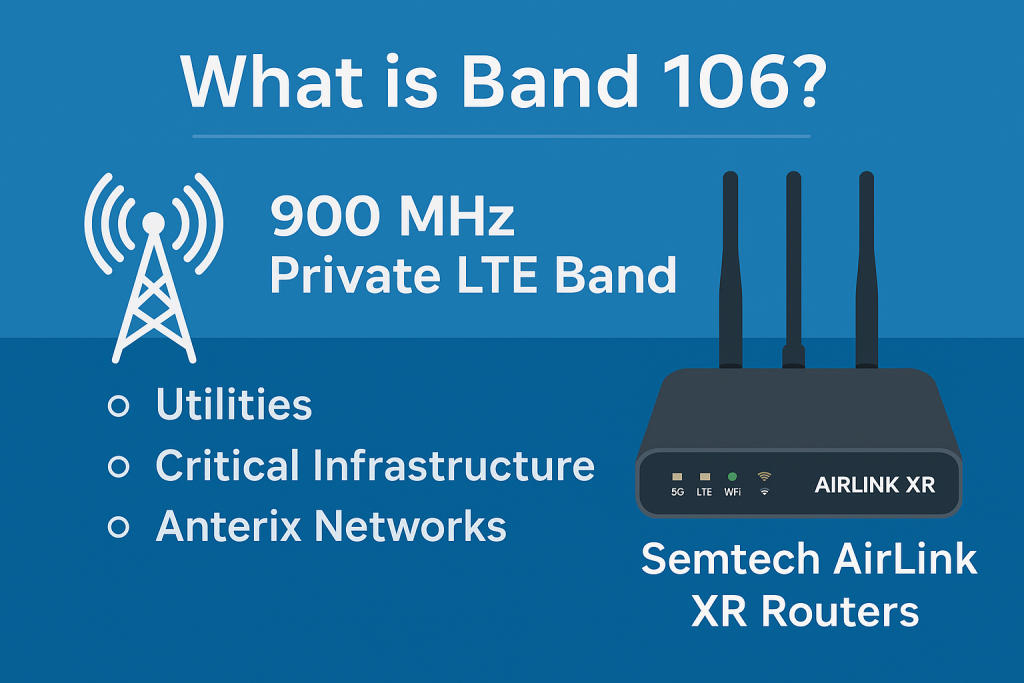
What Is Band 106? The 900 MHz Private LTE Band Powering Modern Utilities
Meta description:
Band 106 is a 900 MHz private LTE and 5G band built for utilities and critical infrastructure, not consumer smartphones. Learn what it is, who it is for, and which manufacturers support it, including Semtech AirLink XR routers on Anterix networks.
As more utilities and critical infrastructure providers roll out private LTE and private 5G networks, one question keeps coming up:
What exactly is Band 106, and do we need it?
If you work in grid operations, SCADA, field networking, or you design solutions for those customers, Band 106 is going to be part of your vocabulary. This article walks through what it is, who it serves, and which vendors support it today, with a special focus on Semtech AirLink routers used in Anterix based networks.
Quick overview
At a high level:
- Band 106 (B106) is a 3GPP LTE band in the 900 MHz range with paired spectrum that utilities can use for private LTE and future private 5G networks.
- The 5G version is called n106, standardized alongside LTE Band 106 so utilities can evolve from LTE to 5G using the same spectrum.
- In the United States, this spectrum is held primarily by Anterix, which is building a nationwide 900 MHz platform for private utility networks.
- Semtech AirLink XR60, XR80 Gen2 and XR90 Gen2 routers now support Band 106 on Anterix networks, giving utilities rugged hardware they can deploy at the grid edge.
Think of Band 106 as a purpose built utility band: long range, deep penetration, and designed for private, highly controlled networks rather than consumer smartphone traffic.
What is Band 106 from a technical perspective?
From the standards point of view, Band 106 is a paired FDD band in the 900 MHz spectrum that sits in the same neighborhood as traditional 900 MHz mobile Band 8, but is defined specifically for new private broadband networks.
Key characteristics:
- Technology families
- LTE: Band 106 (B106)
- 5G NR: n106
- Frequency range
- The Band 106 uplink and downlink fall within the 896–901 MHz and 935–940 MHz blocks that Anterix controls across much of the United States.
- Standardization
- Band 106 and n106 were introduced in 3GPP Release 18 with a clear focus on private utility broadband and future 5G evolution for critical infrastructure.
Why 900 MHz matters:
- Excellent propagation
- Lower frequencies travel farther, bend around obstacles, and penetrate buildings and vegetation better than higher frequency midband spectrum such as CBRS at 3.5 GHz.
- Large coverage footprints
- Utilities can cover wide service territories and remote infrastructure with fewer sites, which is essential for rural lines, substations, pump stations, tanks, and pipelines.
In short, Band 106 is designed to be the coverage and reliability layer of a utility’s private wireless network.
Who is Band 106 for?
Band 106 is not aimed at consumer smartphones. It is designed for organizations that operate critical infrastructureand need long range, highly reliable connectivity that they can control.
Electric utilities
Electric utilities are the primary audience for Band 106. Common use cases include:
- Advanced metering infrastructure (AMI) and smart meters
- Distribution automation and reclosers
- Substation connectivity and protection
- DER integration for solar, wind, and battery sites
- Field crews and mobile command vehicles
Band 106 is a strong fit for mission critical smart grid applications where public networks may not offer enough control, priority, or coverage.
Gas, oil, and pipeline operators
Pipeline and energy companies often operate in remote regions where public LTE is limited. Band 106 private LTE gives them a way to:
- Monitor and control remote compressor stations
- Collect sensor data for pressure, flow, and leak detection
- Connect field crews and vehicles over large territories
Water and wastewater utilities
Water and wastewater operators are also good candidates for Band 106 private LTE:
- Pump stations and lift stations
- Tank level monitoring
- Distributed valve and pressure management
These networks need consistent coverage in places where public LTE can be unreliable or congested.
Other critical infrastructure and industrial sites
Beyond core utilities, Band 106 can support:
- Transportation authorities and rail
- Ports and logistics providers
- Industrial and manufacturing sites that require resilient connectivity even during disasters
The common theme is high consequence operations where connectivity must be available when storms hit, power is unstable, or public networks are overloaded.
Band 106 and Anterix
In the United States, Band 106 and Anterix are tightly linked.
- Anterix is the largest holder of licensed spectrum in the 900 MHz band (896–901 / 935–940 MHz) and has positioned that spectrum for private LTE and 5G networks serving utilities and other critical infrastructure.
- Anterix led the push to standardize Band 106 in 3GPP and has built an Anterix Active Ecosystem with more than one hundred solution partners including radio, router, module, and device vendors.
For many utilities, “Band 106” essentially means “Anterix 900 MHz private LTE and future 5G.”
Which manufacturers support Band 106?
The Band 106 ecosystem is growing quickly. Below is a snapshot of key players as of late 2025.
Network and RAN vendors
Nokia
- Worked with Anterix to complete the first successful Band 106 data call, demonstrating how the band can underpin private 5G for utilities.
- Offers radio solutions that support Band 106 as part of broader private wireless portfolios for utilities.
Other RAN partners
- Additional providers are building Band 106 capable radios for private LTE and 5G, often with dual band designs that combine 900 MHz with midband options like CBRS for extra capacity at key sites.
Router and gateway vendors
This is where Band 106 becomes very real for 5Gstore customers, since routers and gateways are what you actually install in substations, cabinets, and vehicles.
Semtech AirLink XR series
Semtech (formerly Sierra Wireless) has been one of the fastest movers in adding Band 106 support to rugged routers aimed at utilities:
- The AirLink XR60 5G router supports Anterix 900 MHz spectrum standardized as Band 106, alongside commercial LTE and 5G SA bands. This makes the XR60 a compact, ultra rugged option for substations, reclosers, and field cabinets that need a mix of public and private connectivity.
- Semtech has highlighted the XR60 as a tool for building resilient, future ready utility networks that extend visibility and control all the way to the grid edge.
- AirLink OS 5.3 introduces Anterix Band 106 support for XR60 along with on premises management and other enhancements for mission critical users, which is especially attractive to utilities that prefer to keep management entirely under their control.
Semtech has also expanded Band 106 support to larger XR platforms for public safety and utility deployments:
- AirLink XR80 Gen2 and XR90 Gen2 routers include extended band support that specifically calls out Band 106 for Anterix private LTE networks. These platforms add high performance 5G radios, Wi Fi 6, and support for 5G network slicing, which can be valuable where utilities share infrastructure with public safety or other agencies.
That combination of rugged hardware, Band 106 support, and flexible management options makes the XR family a core part of many early private utility networks.
Other device vendors
Alongside Semtech, multiple module and device vendors are building Band 106 capable hardware that is certified in the Anterix ecosystem, including:
- Cellular modules for embedded devices and smart grid equipment
- Field devices such as fault indicators and recloser controllers that talk directly over Band 106
- Edge gateways that bridge legacy serial or Ethernet equipment onto private LTE
The Anterix ecosystem program continues to add partners, so the list of Band 106 capable devices will keep growing.
Antenna vendors
Most Band 106 deployments use wideband LTE antennas that cover 617–960 MHz, with performance optimized across the low band cellular range.
When you evaluate antennas for Band 106:
- Look for specifications that explicitly cover the 896–940 MHz region
- Aim for antenna designs that combine 5G low band support with midband frequencies if you plan to mix Band 106 with CBRS or carrier bands
Many rugged omnidirectional and panel antennas that 5Gstore carries already support this full low band range, which makes them good candidates for both public LTE and Band 106 private LTE use.
Using AirLink B106 capable routers in an Anterix network
Semtech’s documentation for AirLink routers includes guidance specifically about using B106 capable routers in an Anterix network. While some of that content lives in customer portals, the practical takeaways are straightforward.
1. Confirm hardware and software
Band 106 support depends on both hardware and firmware:
- Use AirLink XR60 5G, XR80 Gen2, or XR90 Gen2 models that list Anterix Band 106 support in their specifications.
- Ensure the router is running a recent AirLink OS release that includes B106 support, such as AirLink OS 5.3 for XR60.
At 5Gstore, we can ship AirLink routers pre updated to the correct version and tested before they leave the warehouse.
2. Validate SIMs, APNs, and network settings
Anterix based networks typically use:
- A specialized SIM profile tied to the utility’s PLMN
- One or more APNs dedicated to private LTE traffic
If a router shows LTE signal but does not attach to the Anterix network, the first checks should be:
- SIM inserted correctly and activated
- Correct APN configured
- PLMN selection aligned with the utility’s private network
Even when the router supports Band 106, incorrect SIM or APN configuration can prevent attachment, so validating these basics is critical.
3. Understand Band 8 and Band 106 interaction
Some Anterix networks use a configuration where US Band 8 and 3GPP Band 106 are enabled together as a combined group. If the radio is not configured as expected, the router might:
- See LTE service but attach in a way that does not deliver the intended Band 106 performance
- Prefer other bands or PLMNs if they are still allowed in the configuration
In those cases, you may need to:
- Review band selection or band locking options in the AirLink OS interface
- Work with the network operator to confirm how Band 106 and Band 8 are broadcast and which settings they recommend on the router side
This is another area where pre staging and lab testing can save a lot of time.
4. Use AirLink management tools for visibility
With AirLink OS and the AirLink management platforms, utilities can:
- See which band and PLMN each router is actually using
- Capture logs when a router fails to attach to the expected Band 106 cell
- Push configuration changes in bulk if band or network settings need to be updated
AirLink OS 5.3 also adds new management flexibility, including on premises management options for organizations that do not want their device data in the cloud.
5Gstore can help you choose the right mix of management tools and pre staging steps so that routers arrive on site ready to join the Anterix network.
What Band 106 means for 5Gstore customers
If you are a:
- Utility planning or expanding a private LTE or private 5G network
- System integrator designing solutions for electric, gas, water, or industrial customers
- Infrastructure operator that wants more control and resilience than public LTE alone can offer
Band 106 should be part of your long term spectrum strategy.
Practically, that means:
- Treat Band 106 as the long range, high reliability layer
- Use it to reach distant assets and maintain control during storms and emergencies.
- Combine Band 106 with midband spectrum and public carriers
- Add CBRS or carrier bands where you need extra capacity at plants, campuses, or dense urban sites.
- Pick hardware that is clearly certified for Band 106 and Anterix networks
- AirLink XR60, XR80 Gen2, and XR90 Gen2 with the proper AirLink OS releases are excellent building blocks for these networks.
- Verify antennas, mounting, and cabling for 900 MHz performance
- Make sure your RF path is optimized for the 896–940 MHz region, not just generic cellular frequencies.
How 5Gstore can help
5Gstore works every day with:
- Investor owned utilities and co ops modernizing grid communications
- Integrators who design and deploy private LTE and 5G solutions
- Industrial and infrastructure customers who need resilient connectivity at the edge
We can help you:
- Select Band 106 capable routers, including Semtech AirLink XR series platforms
- Design antenna and cabling solutions tuned for both Band 106 and other cellular bands
- Pre configure and test devices for Anterix based networks so they are ready to deploy on arrival
- Plan migration paths that combine Band 106 LTE today with 5G n106 in the future
If you are evaluating Band 106 or planning a new private LTE project, share your requirements with us and we will help you turn Band 106 from an acronym into a working network design that supports your operations for years to come.
FAQ
What is Band 106 in simple terms?
Band 106 is a 3GPP LTE and 5G band in the 900 MHz spectrum that is used for private wireless networks rather than public consumer service. In the United States, it is primarily used on Anterix 900 MHz networks that serve utilities and other critical infrastructure. It provides long range coverage and strong signal penetration, which makes it ideal for substations, pipelines, water plants, and remote field assets.
2. How is Band 106 different from other cellular bands like Band 8 or CBRS?
Band 8 is also in the 900 MHz range but was originally defined for public mobile networks. Band 106 is tailored for private broadband networks that utilities can control themselves. CBRS (Band 48) sits much higher at 3.5 GHz and is great for high capacity in local areas such as plants or campuses. Many designs use Band 106 for wide area coverage and reliability, then add CBRS or carrier bands where extra speed and capacity are needed.
Can regular smartphones use Band 106?
Typically, no. Most consumer smartphones are not built to connect to Band 106 or to the private PLMN that utilities use on Anterix networks. Band 106 is mainly for specialized routers, gateways, smart grid devices, and industrial equipment that has been certified for use on these private networks.
Which routers and devices support Band 106 today?
Support for Band 106 is growing quickly. On the router side, Semtech AirLink XR60 5G, XR80 Gen2, and XR90 Gen2 platforms include Band 106 support for Anterix networks when running the proper AirLink OS version. In addition, there are modules, fault indicators, recloser controllers, and other grid devices that are certified in the Anterix ecosystem. When in doubt, check the data sheet for explicit mention of Band 106 or talk with a 5Gstore specialist.
What should I check before deploying an AirLink router on a Band 106 Anterix network?
There are a few key items to verify before you roll out hardware in the field:
Confirm the router model supports Band 106 and Anterix networks
Make sure it is running an AirLink OS release that includes B106 support
Install and activate the correct Anterix SIM and APN settings
Validate band selection or band locking if your network uses both Band 8 and Band 106
Use properly tuned low band antennas that perform well in the 896 to 940 MHz range
5Gstore can pre configure and test AirLink routers so they arrive ready to attach to your Band 106 network.