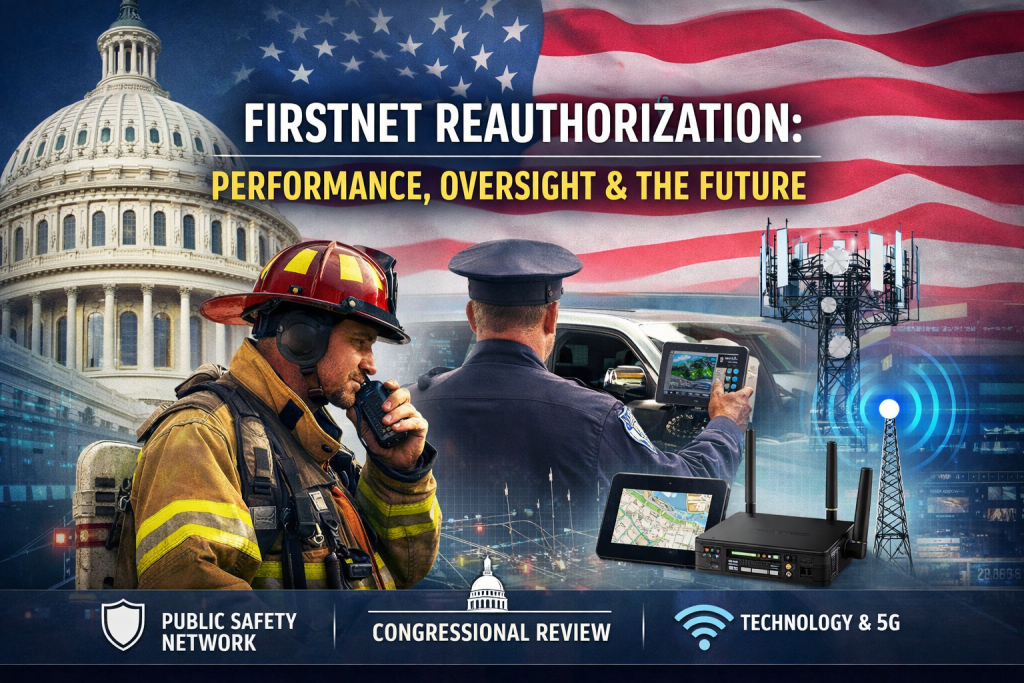
Congress Reviews FirstNet: Performance, Accountability, and What Comes Next
Public safety communications were in the spotlight as the House Energy and Commerce Committee’s Subcommittee on Communications and Technology held a hearing focused on evaluating FirstNet’s performance, accountability, and upcoming reauthorization. With FirstNet’s current authorization set to expire in the near future, lawmakers are taking a closer look at how the nationwide public safety broadband network is operating today and how it should evolve going forward.
For first responders, agencies, and organizations that depend on mission-critical connectivity, this conversation matters. Decisions made during reauthorization could shape public safety communications for the next decade.
What Is FirstNet and Why It Exists
First Responder Network Authority, commonly known as FirstNet, was created to address a long-standing problem in emergency response: unreliable and congested communications during large-scale incidents. Built as a nationwide LTE and 5G-capable network dedicated to public safety, FirstNet provides first responders with priority and preemption, helping ensure they stay connected when commercial networks are overwhelmed.
Since its launch, FirstNet has expanded coverage, added features designed specifically for public safety, and become deeply embedded in how many agencies operate day to day.
Why Congress Is Reviewing FirstNet Now
The hearing centered on three major themes:
- Performance – Has FirstNet delivered on its promise of reliable, nationwide public safety connectivity?
- Accountability – Are the governance and oversight structures strong enough to ensure public safety needs remain the top priority?
- Reauthorization – What changes, if any, should be made before extending FirstNet’s authority?
Lawmakers from both parties generally acknowledged that FirstNet has been a major step forward for public safety communications. At the same time, they raised questions about long-term oversight, transparency, and how responsibilities are divided between the organizations involved in managing the network.
Oversight and Governance Questions
A recurring topic during the hearing was who is ultimately responsible for what. While FirstNet operates under a public-private partnership model, some lawmakers expressed concern that overlapping roles could make accountability less clear.
Discussions focused on whether clearer lines of authority would improve transparency, strengthen oversight, and ensure that performance expectations are consistently met. These governance details may sound abstract, but they directly influence how the network is maintained, upgraded, and expanded.
Transparency and Long-Term Contracts
Another issue raised was visibility into long-term contractual arrangements supporting FirstNet. Lawmakers emphasized the importance of ensuring Congress and the public have sufficient insight into how funds are used and how performance is measured over time.
For vendors, integrators, and agencies that rely on FirstNet-compatible equipment, contract clarity matters. Network investments, device roadmaps, and deployment strategies are all influenced by how the underlying infrastructure is governed and funded.
What Reauthorization Could Mean
Reauthorization is not just a formality. It is an opportunity for Congress to refine how FirstNet operates, clarify oversight responsibilities, and reinforce public safety’s role in guiding the network’s future.
Potential outcomes could include:
- Updated governance structures
- Stronger reporting and accountability requirements
- Adjustments to how performance is evaluated
- Long-term stability for agencies planning multi-year deployments
For the public safety ecosystem, reauthorization provides reassurance that FirstNet will remain a cornerstone of emergency communications while continuing to evolve alongside new technologies.
What This Means for 5Gstore Customers
For organizations deploying routers, antennas, and networking equipment into public safety environments, FirstNet’s future has real-world implications:
- Agencies may continue expanding FirstNet-based deployments as confidence in long-term authorization increases
- Equipment compatibility and certification requirements remain critical
- Long-term network stability supports multi-year purchasing and upgrade plans
- Continued investment in LTE and 5G public safety infrastructure is likely
As Congress moves toward reauthorization, staying informed helps agencies and solution providers make smarter connectivity decisions. Questions? Contact 5Gstore.
Frequently Asked Questions
What is FirstNet?
FirstNet is a nationwide broadband network dedicated to first responders and public safety agencies. It provides priority and preemption to help ensure reliable communications during emergencies.
Why does FirstNet need reauthorization?
Congress originally authorized FirstNet for a limited period. Reauthorization is required to extend its authority and ensure continued operation and oversight.
Has FirstNet been successful?
Most lawmakers and public safety stakeholders agree that FirstNet has significantly improved emergency communications, particularly during disasters and large-scale incidents. The current review focuses on how to strengthen and improve it going forward.
Could reauthorization change how FirstNet operates?
Yes. Reauthorization may introduce changes related to governance, accountability, transparency, and performance reporting.
Does this affect the equipment agencies use?
Potentially. While existing devices will continue to work, long-term network planning and future requirements could influence equipment selection, certifications, and deployment strategies.
Is FirstNet only LTE, or does it include 5G?
FirstNet started as an LTE network but continues to evolve and incorporate 5G technologies to support higher speeds, lower latency, and new public safety applications.