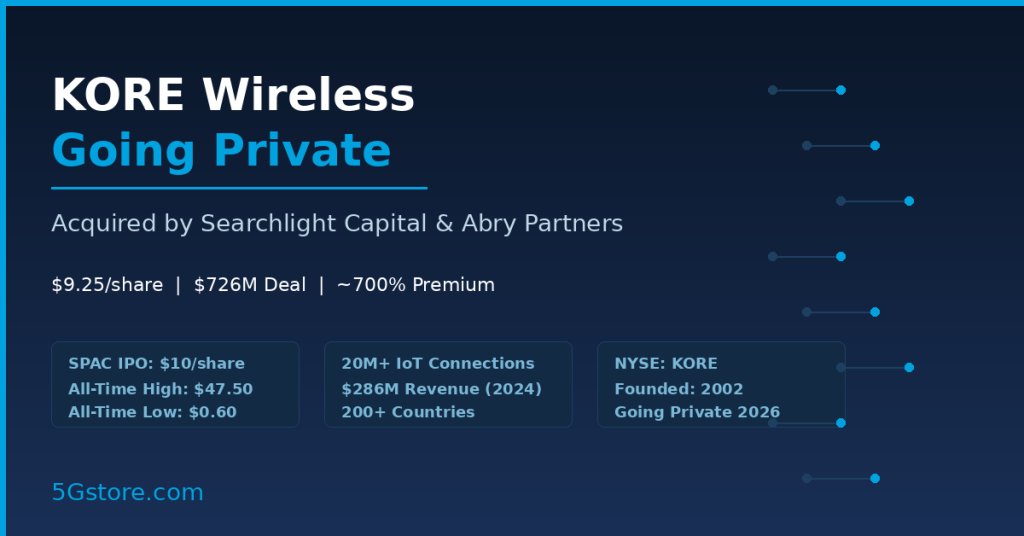
KORE Group Holdings (NYSE: KORE), one of the largest independent IoT connectivity providers in the world, announced today that it has agreed to be acquired by private equity firms Searchlight Capital Partners and Abry Partners in an all-cash deal valued at approximately $726 million. Under the agreement, shareholders will receive $9.25 per share, and KORE will become a privately held company once the transaction closes, which is expected in Q2 or Q3 of 2026.
This is a significant development in the IoT connectivity space, and it is worth understanding what KORE does, how their time as a public company played out, and what this deal signals for the broader industry.
Who is KORE Wireless?
Founded in 2002 and headquartered in Atlanta, Georgia, KORE is what the industry calls an IoT “hyperscaler.” The company operates as a global IoT MVNO (Mobile Virtual Network Operator), providing cellular connectivity, device management, location-based services, and managed IoT solutions to enterprise customers. KORE does not own its own cellular towers. Instead, it aggregates connectivity across multiple carriers, offering businesses a single platform to manage IoT deployments across more than 200 countries and territories.
Think of KORE as the company that makes it possible for a fleet management system to have thousands of vehicles reporting their GPS location in real time, or for a connected health device to transmit patient data from a rural clinic to a hospital. They provide the connectivity backbone, the SIM cards (including eSIMs), and the management platform that lets businesses deploy IoT at scale without negotiating individual deals with every wireless carrier in every country.
As of mid-2025, KORE manages over 20 million active IoT connections worldwide and reported $286.1 million in revenue for fiscal year 2024. They serve customers in healthcare, fleet management, asset tracking, industrial manufacturing, and communications.
KORE’s Rocky Road as a Public Company
KORE went public on October 1, 2021 through a SPAC (Special Purpose Acquisition Company) merger with Cerberus Telecom Acquisition Corp (CTAC). The SPAC was backed by Cerberus Capital Management and led by Tim Donahue, the former Executive Chairman of Sprint Nextel. The deal valued the combined company at approximately $1.01 billion in enterprise value at the $10 per share PIPE price.
For anyone unfamiliar with SPACs, these are shell companies that raise money through an IPO with the sole purpose of merging with a private company to take it public. SPACs became wildly popular in 2020 and 2021 as an alternative to the traditional IPO process. Hundreds of companies went public this way, and while some have thrived, many have seen their stock prices collapse after the initial hype wore off. KORE, unfortunately, falls squarely in the latter camp.
Here is a timeline of KORE’s stock price journey:
- October 2021 (SPAC debut): KORE began trading on the NYSE at roughly $10 per share, consistent with the standard SPAC pricing.
- October 14, 2021 (All-time high): Just two weeks after listing, KORE’s stock hit its all-time high of $47.50 per share. This was largely driven by low float (many shares were locked up) and speculative interest in IoT plays.
- Late 2021 through 2022: The stock began a steep decline as the broader SPAC market cooled and investors rotated out of speculative growth stocks. Rising interest rates and a shift toward profitability-focused investing hit companies like KORE especially hard.
- May 23, 2023 (All-time low): KORE hit rock bottom at just $0.60 per share. The company was burning cash, carrying significant debt, and struggling to achieve profitability despite growing its connection count.
- September 2024: KORE received notice from the NYSE that it was not in compliance with listing standards, adding further pressure.
- December 18, 2024 (Unaffected price): On this date, the last trading day before Searchlight amended its SEC filing to signal a potential acquisition, KORE closed at approximately $1.17 per share.
- November 3, 2025: The stock was around $3.99 when Searchlight and Abry formally submitted a letter indicating interest in acquiring the company at $5.00 per share.
- February 27, 2026 (Acquisition announcement): The deal is announced at $9.25 per share, and shares surged approximately 76% in a single trading session from their prior close of $5.01.
For investors who bought at the all-time high of $47.50, the $9.25 acquisition price represents a loss of roughly 80%. For those who bought at the SPAC price of $10, it is still a loss of about 7.5%. But for anyone who purchased shares in the sub-$2 range where the stock spent much of 2023 and 2024, this deal delivers a massive windfall. KORE itself highlighted the $9.25 price as a 691% premium over the $1.17 unaffected price from December 2024.
Understanding the Deal Structure
This is not a straightforward outside acquisition. Searchlight and Abry are not new to KORE; they are already deeply embedded in the company’s ownership structure.
Abry Partners is the beneficial owner of approximately 28% of KORE’s outstanding common stock. Abry has been involved since before the SPAC merger, having been KORE’s majority shareholder when the company was private.
Searchlight Capital holds all of KORE’s Series A-1 preferred stock, which carries a liquidation preference of approximately $275 million. Searchlight also holds warrants that could give it about 14% of the company’s common stock on a fully diluted basis.
In essence, the two firms that are acquiring KORE already control significant economic interests in the company. What they are doing now is buying out the remaining public shareholders to take the company private. This type of transaction is sometimes called a “take-private” or “going-private” deal, and it typically happens when major stakeholders believe a company can operate more effectively, invest more aggressively, or restructure more easily without the pressures and costs of being publicly traded.
The deal requires approval from a majority of voting shares, including a separate vote from shareholders who are not affiliated with Searchlight or Abry. It also needs regulatory clearances including Hart-Scott-Rodino antitrust review and Committee on Foreign Investment in the United States (CFIUS) review, which makes sense given KORE’s global IoT operations touch critical infrastructure sectors.
Why Go Private Now?
There are several reasons why going private makes strategic sense for KORE at this point in its lifecycle.
First, the costs and distractions of being a small-cap public company are substantial. SEC reporting requirements, auditing costs, investor relations, and the constant pressure of quarterly earnings reports consume resources that a company like KORE could redirect toward growth. With only about $286 million in annual revenue and a stock price that spent extended periods below $2, KORE was not attracting the kind of institutional investor interest that makes the public market worthwhile.
Second, KORE has been in restructuring mode. The company completed a major restructuring plan in 2024 that delivered over $20 million in annual run-rate savings. It recently turned free cash flow positive for the first time. Under private ownership, KORE can continue this operational transformation without the scrutiny of public markets punishing every quarterly miss.
Third, the IoT market is still growing rapidly but requires patient capital. KORE’s connection count has been growing steadily, from about 12 million at the time of the SPAC merger to over 20 million as of mid-2025. But monetizing those connections and investing in platform capabilities like eSIM technology, analytics, and vertical-specific solutions takes time and sustained investment. Private equity ownership can provide that runway.
What Does This Mean for the IoT Industry?
KORE’s journey from a $1 billion SPAC valuation to a $0.60 stock price to a $726 million take-private deal tells an important story about the state of the IoT connectivity market.
The underlying business is real and growing. Twenty million IoT connections, $286 million in revenue, and a customer base that includes enterprises in healthcare, fleet management, and industrial manufacturing is not trivial. IoT connectivity is not going away; in fact, it is accelerating as 5G, LTE-M, and NB-IoT networks continue to expand globally.
However, the public markets were not the right home for this particular company at this particular stage. Many IoT infrastructure companies face a similar challenge: they have recurring revenue, steady growth, and a long runway, but they also carry heavy debt loads, require ongoing investment, and lack the kind of headline-grabbing growth rates that excite public market investors accustomed to software companies growing at 30% or more per year.
For businesses that rely on KORE’s services, this deal should be viewed as a stabilizing event. Rather than worrying about NYSE compliance warnings and stock price volatility, KORE’s management can now focus entirely on serving customers and growing the platform. The company’s CEO, Ron Totton, framed the deal as providing “seasoned and strategically aligned investors to accelerate our vision as a private, customer-centric IoT leader.”
What is a SPAC, and Why Did So Many Struggle?
For readers less familiar with the financial mechanics, a SPAC (Special Purpose Acquisition Company) is essentially a blank-check company. Investors put money into a shell company at $10 per share, and the SPAC’s management team then goes out and finds a private company to merge with. The private company gets to become publicly traded without going through the traditional IPO process.
SPACs surged in popularity during 2020 and 2021 when low interest rates and abundant capital created a frenzied deal-making environment. Hundreds of companies went public through SPACs, including many in the EV, space, and IoT sectors. The problem is that many of these companies were not yet ready for the rigors of public market life. Projected growth rates used in SPAC pitch decks often proved wildly optimistic, and once the easy money environment ended with rising interest rates in 2022, investors fled.
KORE’s experience is unfortunately typical. The company went public at a $1 billion valuation during peak SPAC mania, the stock briefly spiked to $47.50 on speculative momentum and low float, and then spent the next two-plus years declining as the reality of building a profitable IoT business on public market timelines set in. Now, with the take-private at $726 million, the company gets a fresh start under more patient ownership.
5Gstore Take
The KORE acquisition is a fascinating case study in the intersection of IoT growth, public market dynamics, and private equity strategy. For those of us in the cellular networking and IoT space, the takeaway is clear: the demand for IoT connectivity is real and growing, but building the infrastructure businesses that enable it requires time, patience, and the right ownership structure. KORE’s new private ownership should allow the company to invest in its platform, expand its 20-million-connection base, and better serve the enterprises that depend on its services, all without the quarterly noise of public markets. If you have questions about IoT connectivity solutions for your business, contact the 5Gstore team for expert guidance.
FAQ
What is happening with KORE Wireless?
KORE Group Holdings (NYSE: KORE) has agreed to be acquired by Searchlight Capital Partners and Abry Partners in an all-cash deal at $9.25 per share, valuing the transaction at approximately $726 million. Once the deal closes, KORE will become a privately held company and will no longer trade on the NYSE.
What is the acquisition price for KORE stock?
KORE shareholders will receive $9.25 per share in cash. This represents a 691% premium over the stock’s unaffected closing price of approximately $1.17 on December 18, 2024, and a 132% premium over the $3.99 close on November 3, 2025, before the buyers formally indicated acquisition interest.
Who is acquiring KORE Wireless?
Searchlight Capital Partners and Abry Partners, both private equity firms, are acquiring KORE. Neither firm is a newcomer to the company. Abry already owns approximately 28% of KORE’s common stock, and Searchlight holds all of the company’s Series A-1 preferred stock with a $275 million liquidation preference.
When will the KORE acquisition close?
KORE expects the transaction to close during Q2 or Q3 of 2026, subject to shareholder approval, Hart-Scott-Rodino antitrust clearance, CFIUS review, and other customary conditions.
What does KORE Wireless do?
KORE is a global IoT connectivity provider that manages over 20 million active IoT connections across more than 200 countries. The company provides SIM cards, eSIM technology, device management, and analytics services that enable businesses to deploy and manage connected devices at scale in sectors like healthcare, fleet management, and industrial manufacturing.
What was KORE’s all-time high stock price?
KORE’s stock reached an all-time high of $47.50 on October 14, 2021, just two weeks after going public through a SPAC merger. The stock subsequently declined to an all-time low of $0.60 in May 2023 before recovering.
What is a SPAC?
A SPAC (Special Purpose Acquisition Company) is a shell company that raises money through an IPO and then uses those funds to acquire a private company, effectively taking it public without a traditional IPO. KORE went public in 2021 through a SPAC merger with Cerberus Telecom Acquisition Corp at a $10 per share reference price.