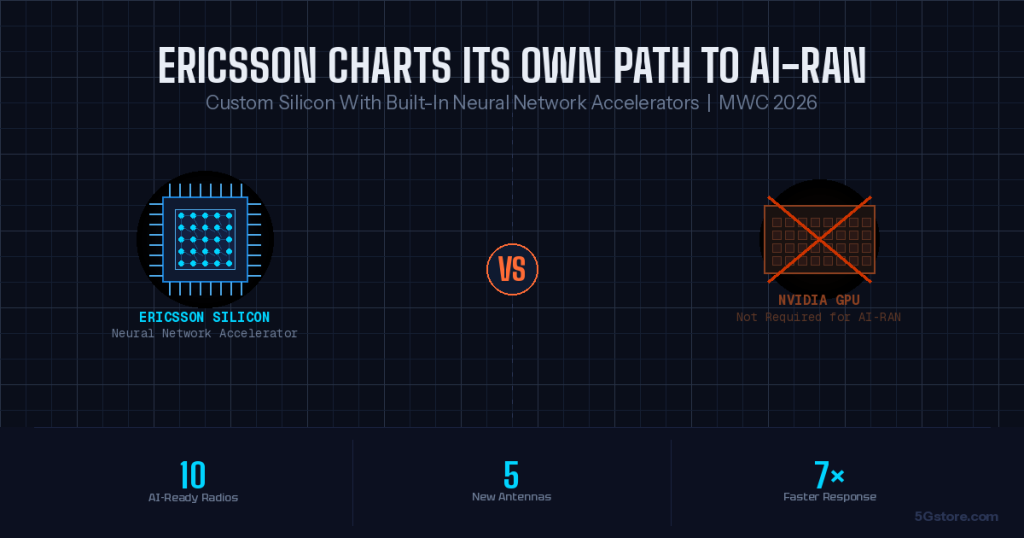
The battle over what silicon should power the next generation of AI-enhanced 5G networks is heating up, and Ericsson just made its position crystal clear: you don’t need Nvidia to do AI-RAN.
Two Nordic Giants, Two Very Different Strategies
The 5G radio access network (RAN) equipment market is at a crossroads. As artificial intelligence becomes increasingly central to how mobile networks optimize performance, the question of which chips should run these AI workloads has become one of the industry’s most consequential debates.
On one side, Nokia made a major bet last year by accepting a $1 billion investment from Nvidia and welcoming the chip giant as its second-largest shareholder. Nokia’s plan is to redesign its 5G and future 6G RAN software to run on Nvidia’s powerful but energy-hungry GPUs — the same chips that power AI data centers around the world.
Ericsson is going in a completely different direction.
At a pre-MWC Barcelona 2026 event in London, Ericsson showcased its first wave of AI-RAN products — and they’re all built to run on Ericsson’s own purpose-built silicon. No Nvidia GPUs required.
What Ericsson Actually Announced
Ericsson’s new product portfolio heading into MWC 2026 includes three main pillars:
AI-Ready Radios: Ten next-generation radios including new Massive MIMO and remote radio units. These feature Ericsson Silicon with integrated neural network accelerators — programmable matrix cores built into the company’s Many-Core Architecture that are specifically optimized for AI and machine learning workloads.
Advanced Antennas: Five new interleaved and passive antennas designed to enhance spectrum utilization, maximize uplink performance, and simplify site design. The passive antennas use a trio net design for improved carrier aggregation and spectral efficiency.
AI-Powered RAN Software: New software features including AI-managed beamforming, AI-powered outdoor positioning, instant coverage prediction using AI models, a latency prioritized scheduler, and low latency mobility that delivers up to seven times faster response times.
The key takeaway: Ericsson found that the beamforming silicon already embedded in its Massive MIMO radios could be repurposed for AI inference by adding neural network accelerators. Rather than bolting on expensive external GPU hardware, Ericsson extended the capabilities of silicon it was already shipping.
Why Custom Silicon Over GPUs?
Ericsson’s argument essentially comes down to three factors: cost, power consumption, and independence.
Total Cost of Ownership (TCO): Per Narvinger, head of Ericsson’s mobile networks business, has been direct on this point — custom silicon continues to deliver better TCO than alternatives, and Ericsson doesn’t see that changing anytime soon. Nvidia GPUs are powerful, but they were designed for data center AI training, not for the harsh, power-constrained environment of a cell tower.
Energy Efficiency: GPUs have a reputation for being power-hungry. At a time when carriers are under enormous pressure to reduce the energy consumption of their networks, deploying GPU-class hardware at thousands of cell sites raises real questions about operational costs and sustainability goals.
Avoiding Vendor Lock-In: This is arguably Ericsson’s biggest strategic concern. The company watched Nokia tie itself closely to Nvidia and sees risk in that approach. What happens if Nvidia’s priorities shift? What if a better silicon option emerges in two years? Ericsson wants the flexibility to deploy its software on whatever chip platform makes the most sense — whether that’s its own custom ASICs, Intel CPUs, AMD processors, Arm-based chips, or even eventually Nvidia’s hardware.
The Vendor Lock-In Problem Is Real
The irony of the virtual RAN / cloud RAN movement is that it was supposed to decouple hardware from software and give carriers more choice. In practice, the opposite has happened in some cases. Ericsson’s own cloud RAN products currently only have commercial support for Intel processors. AMD, Arm, and Nvidia remain at the “prototype support” stage despite years of promises about silicon diversity.
Ericsson is actively working to fix this through hardware abstraction layers (HALs) and the adoption of standardized interfaces like BBDev to decouple its RAN software from any specific silicon vendor. The goal is what Narvinger calls “one software track” that can be deployed across multiple hardware platforms.
This is easier said than done. The lower layers of RAN software — particularly Layer 1 (the physical layer) — are extremely compute-intensive and tightly coupled to the underlying hardware. Higher-layer software is more portable, but Layer 1 requires platform-specific optimization, which is why true multi-vendor silicon support has been so slow to materialize.
What This Means for Carriers and Enterprises
For organizations deploying or expanding 5G networks, Ericsson’s strategy has several practical implications:
No GPU Tax: If Ericsson can deliver meaningful AI-based network improvements using its existing custom silicon, carriers won’t need to invest in expensive GPU infrastructure at cell sites. This is particularly relevant for enterprise private 5G deployments where TCO sensitivity is high.
Future Flexibility: Ericsson’s commitment to software portability means that as the silicon landscape evolves — and it’s evolving rapidly — carriers using Ericsson equipment should eventually be able to take advantage of whatever chip platform offers the best performance and economics, without a forklift upgrade.
AI Benefits Now: Unlike approaches that require new GPU hardware to be deployed, Ericsson’s neural network accelerators are integrated into radios that carriers can deploy today. Features like AI-managed beamforming and AI-native link adaptation are available on current-generation hardware.
The RAN Market Context: It’s worth noting that the global RAN market has actually been shrinking — from roughly $45 billion in 2022 to about $35 billion more recently. This makes TCO arguments even more compelling, as carriers are looking to do more with less, not spend more on exotic new silicon platforms.
The Bigger Picture: Who’s Right?
The honest answer is that nobody knows yet. Nokia is betting that GPUs will be essential as AI becomes deeply embedded in how networks operate, and that Nvidia’s massive R&D investment and ecosystem will prove decisive. Ericsson is betting that purpose-built silicon and software flexibility will deliver better economics and more optionality.
There’s also a wild card: other silicon platforms like Google’s Tensor Processing Units (TPUs) and various Arm-based processors from AWS and others are emerging as potential RAN compute options. The market is more fragmented and uncertain than it’s been in years.
What’s clear is that AI is coming to the RAN regardless of which silicon runs it. For 5Gstore customers deploying cellular networking solutions, the good news is that competition between these approaches should drive innovation and ultimately lower costs. The vendors that can deliver real AI-powered network improvements — better spectral efficiency, lower latency, improved energy performance — without requiring expensive new infrastructure will likely win.
Ericsson’s MWC 2026 showing suggests they believe they can be that vendor. Questions? Reach out to 5Gstore.com
Frequently Asked Questions
What is AI-RAN?
AI-RAN refers to the integration of artificial intelligence and machine learning directly into the radio access network to improve performance, efficiency, and automation. This can include AI-managed beamforming, intelligent channel estimation, predictive coverage optimization, and automated network resource management.
Why does it matter whether AI-RAN runs on GPUs or custom silicon?
The choice of underlying chip platform affects the cost, power consumption, and deployment complexity of AI-RAN solutions. GPUs are powerful but expensive and energy-hungry. Custom silicon can be optimized for specific RAN tasks, potentially delivering better total cost of ownership. The choice also impacts vendor dependency and future flexibility.
What is Ericsson Silicon?
Ericsson Silicon is the company’s family of custom-designed application-specific integrated circuits (ASICs) built specifically for RAN processing. The latest versions include neural network accelerators – programmable matrix cores that can run AI and machine learning workloads directly in the radio hardware.
How does Nokia’s approach differ from Ericsson’s?
Nokia accepted a $1 billion investment from Nvidia and plans to build its next-generation 5G and 6G RAN software to run on Nvidia’s GPU platform. Ericsson has chosen to invest in its own custom silicon with built-in AI capabilities while maintaining the goal of software portability across multiple chip platforms.
What was announced at MWC 2026?
Ahead of MWC Barcelona 2026 (March 2-6, 2026), Ericsson unveiled ten new AI-ready radios with neural network accelerators, five advanced antennas, and new AI-powered RAN software features including AI-managed beamforming, AI-powered positioning, and latency optimization tools.