Table of Contents
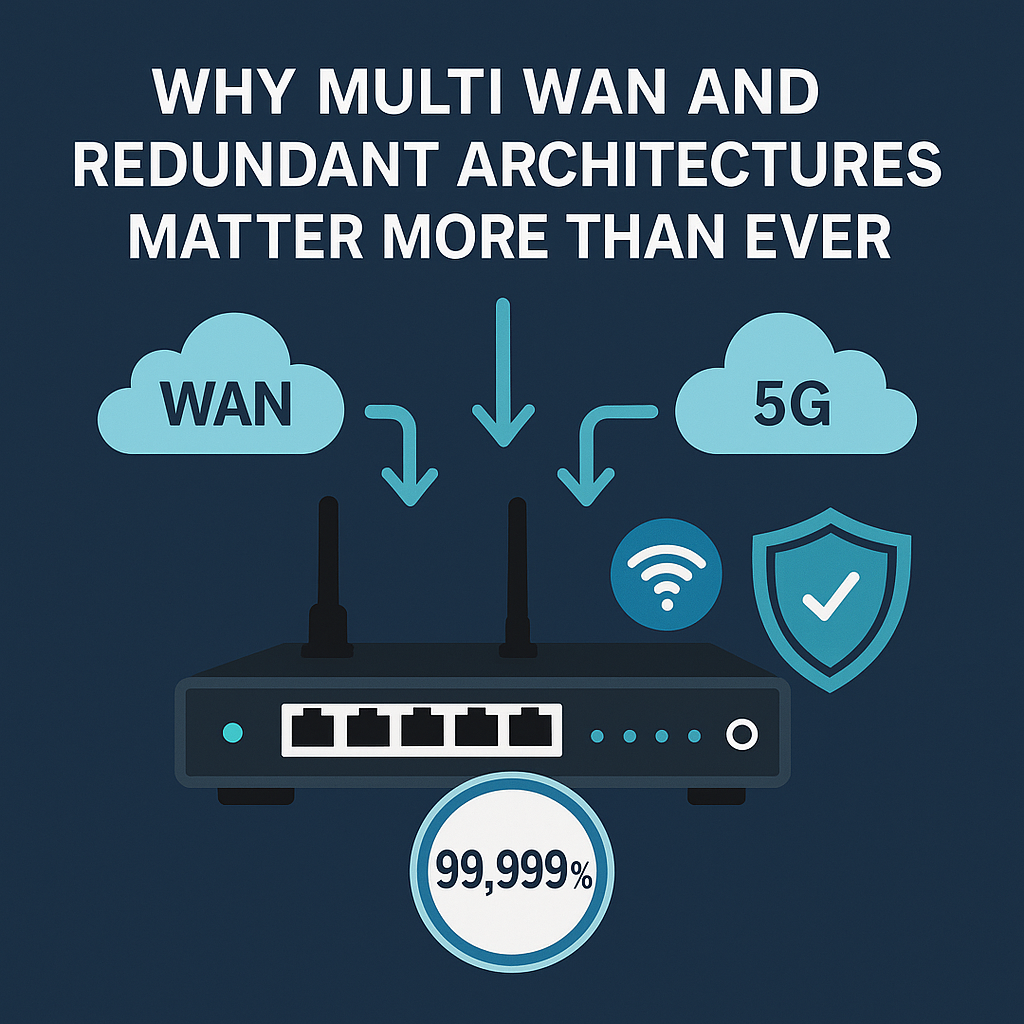
Why Multi WAN and Redundant Architectures Matter More Than Ever
How bonding, carrier diversity, and modern 5G technologies deliver near perfect uptime
When it comes to business connectivity, most companies still rely on a single internet circuit. It might be cable, fiber, or a 5G connection, but the pattern is almost always the same. One connection feeds the entire operation and everyone hopes it stays up. For many businesses, that risk is much greater than they realize.
During a recent technical session, we saw a powerful reminder that reliability is not accidental. It is engineered. By combining diverse WAN links, hardware redundancy, and intelligent bonding technologies, businesses can shrink their annual downtime from hours to minutes. Even better, they can often reduce costs at the same time.
This post breaks down the core lessons and real world examples that show why multi WAN strategies are becoming a must have for retailers, healthcare, event operators, and any organization where downtime equals lost revenue.
Why a Single Connection Is Not Enough
A single WAN connection averages about 99 percent uptime. That sounds good until you translate it into real world numbers. You can expect roughly 8 hours of downtime each year. For a retail store, a clinic, or a remote worker handling transactions, 8 hours of outages can mean thousands of dollars in losses.
Add a second WAN connection and reliability typically improves to 99.9 percent. That reduces annual downtime to about 52 minutes. Add a third WAN connection and uptime jumps to around 99.99 percent, which is only about 5 minutes a year.
Simply put, each added WAN link reduces risk dramatically. Even better, modern bonding technologies can use all of those connections at the same time, which means your backup bandwidth becomes active bandwidth.
The Value of Redundant Hardware
WAN diversity solves one part of the problem, but hardware failures can still take down a network. This is where high availability router pairs come into play. Two routers working together create hardware redundancy that keeps the network operational even if one device fails or needs a firmware upgrade.
A complete high availability stack using dual 5G routers usually costs around 2,000 to 2,500 dollars. That is less than many enterprise routers that do not offer the same resiliency. With HA, firmware updates can roll through one device at a time with only a brief moment of transition while traffic moves to the secondary unit.
Adding two UPS units is recommended as well. One powers the primary equipment bank and one powers the secondary. This eliminates the risk of a power failure taking out both devices at once.
SpeedFusion: Using All WAN Links at Once
Traditional routers treat backup connections as passive circuits that sit idle until the primary fails. SpeedFusion technology flips that model. Instead of leaving backup bandwidth unused, it actively uses the available WAN connections during normal operation.
Key SpeedFusion modes include:
Hot failover
Traffic moves from one WAN to another without dropping video calls, transactions, or VPN sessions.
WAN smoothing
Forward error correction adds parity packets to reduce jitter and protect against packet loss. This is especially valuable for 5G, satellite, and any connection that experiences variable latency.
Bandwidth bonding
Multiple WAN links are combined into one logical connection. The system balances traffic across them and increases total throughput.
Dynamic weighted bonding
SpeedFusion constantly evaluates the performance of each WAN link and adjusts how traffic is distributed. This becomes important for environments with mixed networks such as 5G + Starlink + fiber.
SpeedFusion continues to evolve as new technologies roll out. New firmware releases keep improving the algorithms that manage 5G standalone, 5G Advanced, and satellite connections.
Examples That Prove the Value of Multi WAN
The most convincing arguments come from real deployments that show how multi WAN and SpeedFusion can change the economics of connectivity.
Avoiding large installation fees
A retailer needed internet service for a store opening but faced a 50,000 dollar installation bill and a long construction timeline. A 5G router with multiple carriers provided instant service and avoided the wait entirely. That retailer later standardized on 5G for all locations.
Event operators
Large competitive events rely on video production, timing systems, point of sale, and staff connectivity. Some organizations run entire shows using zero touch provisioning from thousands of miles away. Bonded 5G and satellite links create a reliable pipe for thousands of devices.
Mobile healthcare
Mobile medical units commonly run 6 to 10 SIM cards across multiple carriers. This ensures medical records, telehealth tools, and diagnostic systems remain accessible no matter where the vehicle travels.
Large venues
A major event once priced traditional venue internet at about 32,000 dollars. A bonded multi WAN setup using a cellular router cost approximately 12,000 dollars and delivered faster speeds. In many cases a single event pays for the equipment.
Public safety
Police, fire, and EMS vehicles use multiple carriers because different networks recover at different speeds during disasters. Bonding gives them faster reconnection and higher resilience when coverage is unpredictable.
Business
SMB, Mid-size or enterprise can benefit form having multi-wan connections. These days, everything needs the internet from shipping to invoicing to quotes to phones to video conferences.
Carrier Diversity: One Carrier Cannot Do It All
No single cellular provider has universal coverage or universal priority. Each has strengths.
T-Mobile
High capacity sub 6 spectrum and good bandwidth in metro areas.
AT&T FirstNet
Band 14 provides dedicated priority for first responders.
Verizon Frontline
Strong coverage footprint with priority access for public safety.
Different carriers perform better in different regions. Some rural areas depend on roaming partners that only certain carriers support. By combining multiple providers in one device, organizations avoid single carrier blind spots.
A real example illustrated why diversity matters. A business used both fiber and 5G from the same carrier. When a construction accident cut the fiber line, that same cut also took down nearby cellular equipment. Both services failed at the same time. A different carrier’s SIM saved the day by keeping traffic online.
The Peplink Ecosystem and Why It Matters
The Peplink ecosystem ranges from compact devices under 500 dollars to high performance routers that push more than 100 gigabits for large campuses. Everything is managed from a single cloud platform called InControl, which allows teams to deploy, configure, and monitor devices around the world.
The ecosystem includes:
- Cellular routers in all performance tiers
- Antennas designed for 5G and multiband use
- Managed switches with zero touch VLAN provisioning
- SpeedFusion Connect for instant bonding without complex configuration
- FusionHub for hosting virtual SpeedFusion endpoints
- A new 5G USB modem for direct laptop or router integration
The consistent user experience across the entire product line allows small IT teams to support thousands of devices globally.
A Look at Redundant Network Design
A proper high availability design includes multiple stages of protection.
- Two routers in HA mode
- WAN circuits split across multiple switches
- VLAN as WAN to create virtual interfaces
- Multiple carriers for cellular redundancy
- UPS units for each equipment bank
In a recent live configuration example, a complete HA setup including VLAN as WAN, bonding, and eSIM activation was built in about 15 minutes. The secondary device synchronized automatically with no duplicate configuration required.
Practical Takeaways for Any Business
Here are the most important lessons for any organization evaluating network reliability.
- A single connection is a gamble.
- Adding a low cost 5G data plan can recover hours of uptime every year.
- Bonding provides more than failover. It increases usable bandwidth.
- Carrier diversity prevents simultaneous outages when infrastructure fails.
- Hardware redundancy eliminates router failures as a single point of failure.
- High availability stacks are affordable even for small businesses.
- For many companies, the cost of downtime far exceeds the cost of redundancy.
Whether you are supporting a retail store, a healthcare fleet, a large event, or a remote workforce, multi WAN strategies are no longer optional. They are the new baseline for modern connectivity.
If you want help designing a multi WAN or bonded solution, the 5Gstore team has deployed thousands of systems across retail, hospitality, healthcare, logistics, and enterprise environments. Our experts can help you pick the right mix of hardware, carriers, antennas, and configuration for maximum uptime.