Table of Contents
When a disaster knocks out towers, or when first responders are operating far beyond the edge of coverage, “no bars” is not just inconvenient. It can be dangerous.
With AT&T’s advancements, first responders can rely on a more robust communication infrastructure during emergencies, ensuring reliable connections through AT&T’s network.
That is why AT&T’s FirstNet team is moving toward adding a satellite layer to AT&T FirstNet. The goal is simple: fill coverage gaps and extend communications when terrestrial networks cannot reach, or cannot be restored quickly enough through AT&T’s services.
Satellite should not be viewed as a replacement for LTE or 5G. It is a resilience layer, and for public safety that is exactly the point. A layered communications plan can keep teams connected across cities, mountains, deserts, and disaster zones, even when one layer goes down.
Key takeaways
- FirstNet is preparing to use satellite as an additional coverage layer for first responders in remote or disrupted areas.
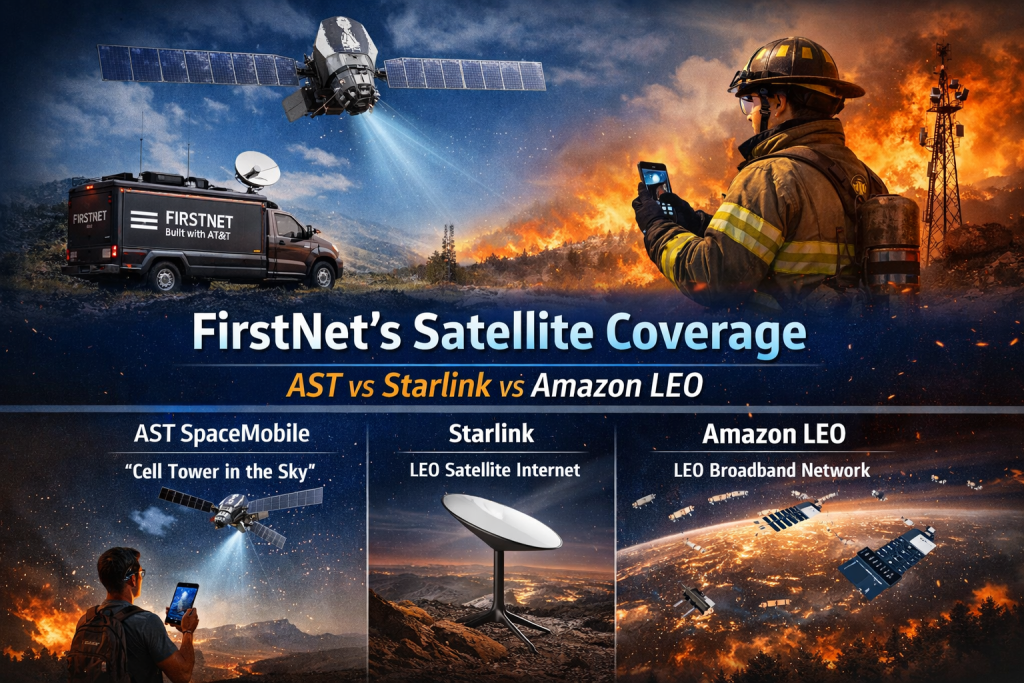
- AST SpaceMobile is positioned like a “cell tower in the sky,” designed to connect directly to everyday smartphones.
- Starlink and Amazon’s LEO networks are best understood as high-speed satellite internet that usually requires a terminal, making them ideal for backhaul and temporary incident networks.
- In real deployments, the best plan is often a mix: terrestrial LTE/5G, satellite broadband for high throughput, and direct-to-phone satellite for coverage extension.
What problem AT&T FirstNet satellite is trying to solve
FirstNet already delivers strong nationwide coverage with public safety features designed for emergencies. But there will always be hard-to-cover places and “worst day” situations where terrestrial infrastructure is damaged, overloaded, or simply not available.
Satellite helps in three specific situations:
- True dead zones: rural areas, mountains, deserts, and offshore regions where building towers is not practical.
- Disaster impact zones: hurricanes, fires, floods, and severe storms where tower sites may be damaged or power and backhaul are disrupted.
- Surge events: major incidents where cellular networks become congested and responders need another path to communicate.
Adding satellite gives FirstNet another option in the toolkit, especially for the moments when speed of restoration matters.
AST SpaceMobile: the “cell tower in the sky” approach
AST’s promise is the one that grabs attention: connect directly to standard smartphones without a dish. That is why you will hear it described as a “cell tower in the sky.”
Think of it this way:
- A traditional cellular network needs towers.
- AST is trying to make satellites behave more like towers from the phone’s perspective.
Why direct-to-phone matters for emergency response
Direct-to-phone satellite is powerful because it keeps communications on the device responders already carry. No extra hardware, no separate hotspot, no truck roll to set up a terminal. If a phone can connect, a responder can communicate.
The practical limitations to understand
Direct-to-phone satellite is not the same as a full terrestrial network. Early deployments tend to be constrained by capacity and coverage density. Performance depends on how many satellites are in orbit, how often they pass overhead, and how much spectrum and network integration is available.
That is why the smartest way to think about AST is:
- A lifeline layer for coverage extension
- A backstop for messaging, voice, and essential data
- A complement to, not a replacement for, terrestrial LTE/5G
Starlink: two very different use cases
When people say “Starlink,” they often mean one of two things, and it is important not to mix them up.
1) Starlink satellite internet (terminal-based)
This is the classic Starlink model. You use a Starlink terminal to get high-speed internet from LEO satellites.
For public safety and critical communications, this is usually a backhaul story:
- Incident command posts
- Mobile command vehicles
- Temporary field offices
- Backup internet for EOCs, hospitals, shelters, and public safety buildings
- Rapid connectivity when fiber or cable is down
With the right router, Starlink can be integrated as just another WAN connection that you can prioritize, fail over, and sometimes bond with cellular.
2) Starlink direct-to-cell (carrier-partner service)
There is also a separate direct-to-cell story in the market. This is closer to the “phone connects without a dish” concept, often focused first on messaging and basic data experiences. It is not the same thing as terminal-based broadband.
Amazon LEO: LEO broadband with a different ecosystem
Amazon’s LEO network is best understood as another broadband satellite option, similar in category to Starlink terminal-based internet.
The big picture:
- It is designed to deliver internet connectivity using customer terminals
- It is a potential alternative or second provider for resilience, coverage diversity, and procurement flexibility
- It is attractive for planned deployments where agencies want a long-term satellite broadband provider and enterprise support options
For emergency response, Amazon’s LEO approach naturally fits the same types of use cases as Starlink broadband:
- Backhaul for incident networks
- Connectivity for remote sites
- Redundant WAN for facilities
- Temporary deployments when terrestrial services are limited
- Check if you are in a Starlink Coverage area
How to choose: direct-to-phone vs satellite broadband
A simple way to decide is to start with the job you need the satellite link to do.
If your priority is “a responder’s phone must work”
Direct-to-phone satellite is the focus. This is the “coverage extension” play, and it is why the AST model is so interesting for public safety.
Best for:
- Texting and basic coordination where towers do not exist
- Voice and essential data as the service matures
- Last-resort connectivity when terrestrial systems are down
If your priority is “we need real bandwidth for a team”
Satellite broadband is the answer. This is where Starlink and Amazon LEO shine.
Best for:
- High-throughput internet at an incident site
- WiFi for multiple users, devices, and applications
- Video, mapping, dashboards, and shared tools
- Backhaul for temporary LTE/5G or mesh networks
If your priority is “we need the most resilient design”
Use both.
- Direct-to-phone for individual device survivability
- Satellite broadband for site-level connectivity and multi-user operations
- Terrestrial cellular as the primary layer whenever possible
5Gstore Take
Satellite is not one product category anymore. It is a set of tools that solve different problems.
AST’s direct-to-phone approach is exciting because it changes what “coverage” can mean for a responder holding a phone at the edge of the map. Starlink and Amazon LEO are the workhorses for fast, high-bandwidth internet that can power an incident network, a command post, or an entire temporary operation.
If you are designing for continuity, the answer is rarely choosing only one. The best approach is building a layered communications plan where each layer covers the others when things go wrong.
FAQ
What does it mean when FirstNet adds satellite coverage?
It means satellite becomes another connectivity layer that can help first responders stay connected in coverage gaps, remote areas, and disaster zones. It is designed to complement terrestrial LTE/5G, not replace it.
Is AST really a “cell tower in the sky”?
That phrase is shorthand for direct-to-phone satellite. The goal is for satellites to connect directly to standard smartphones, reducing the need for additional hardware like satellite terminals.
Will AST replace Starlink for emergency communications?
Not likely, because they solve different problems. AST is positioned around direct-to-phone coverage extension. Starlink is best known for high-speed satellite internet that supports routers, command posts, and multi-user incident networks.
Do responders need special phones for direct-to-phone satellite?
It depends on the provider, the carrier partnership, and the device support. Some approaches aim to work with everyday smartphones, but capabilities may vary by model and network readiness.
What is the biggest advantage of Starlink for public safety?
Bandwidth. Starlink broadband can deliver high-speed internet quickly for an incident site, command vehicle, or facility, making it ideal for multi-user connectivity and data-heavy operations.
How is Amazon LEO different from Starlink?
Amazon’s LEO network is another LEO broadband option designed around terminals and enterprise deployments. For agencies, it can mean more choice, redundancy, and procurement flexibility over time.
Which is better for a mobile command vehicle: AST or Starlink/Amazon LEO?
7)
For a mobile command vehicle, satellite broadband (Starlink or Amazon LEO) is typically the better fit because you need bandwidth for multiple systems and users. Direct-to-phone satellite is better as a personal device lifeline layer.
Can agencies use both satellite broadband and direct-to-phone satellite together?
Yes, and that is often the best design. Satellite broadband supports the incident network, while direct-to-phone satellite helps individual responders stay connected even when they are away from the command site.
What should agencies plan for when adding satellite to their communications stack?
Plan for power, mounting, line-of-sight, router integration, security policies, traffic prioritization, and operational playbooks. Satellite is most effective when it is part of a tested incident response workflow, not just a device in a closet.
How does this impact procurement and standardization?
Many agencies will standardize on a layered approach: terrestrial LTE/5G as the primary path, satellite broadband for incident backhaul, and direct-to-phone satellite as a coverage extension and last-resort option.