Table of Contents
If you have been following WiFi 6E and WiFi 7, you already know the big story: the 6 GHz band unlocked cleaner spectrum, wider channels, and more room for high-performance Wi-Fi. Now the FCC is looking at a new step that could make 6 GHz Wi-Fi even more useful in the real world, especially outdoors and for next-generation devices like AR and VR wearables.
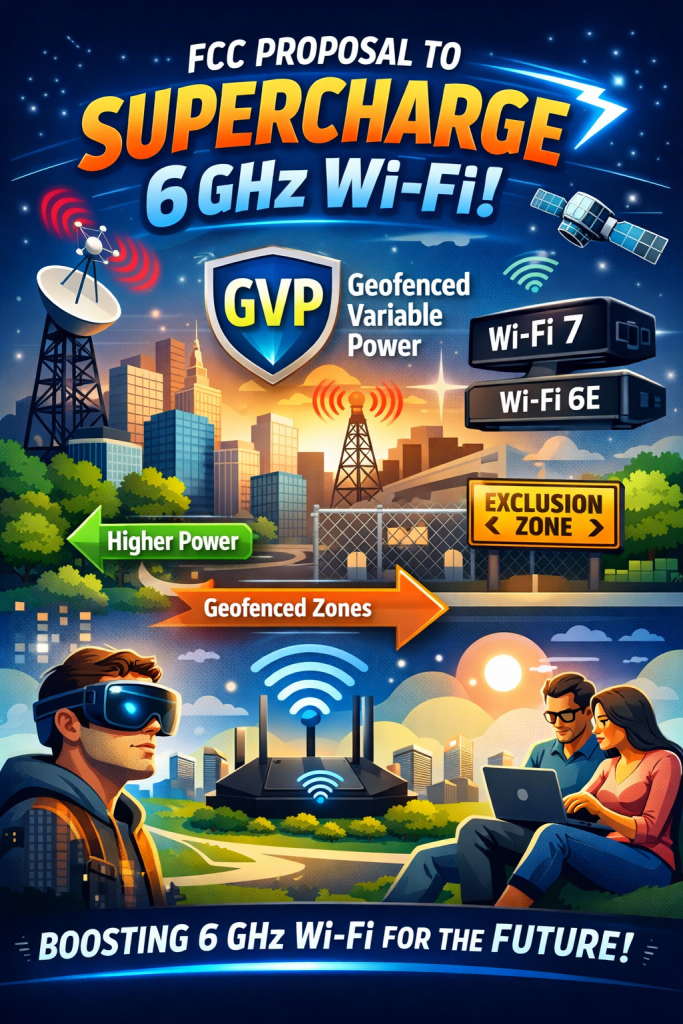
The proposal centers on a new class of unlicensed devices called Geofenced Variable Power, or GVP. The idea is straightforward: allow certain 6 GHz Wi-Fi devices to operate at higher power in more places, while still protecting incumbent users of the band through location-based restrictions.
Let’s break down what is being proposed, why it matters, and what it could mean for your next Wi-Fi upgrade.
Quick refresher: Why 6 GHz matters for Wi-Fi 6E and Wi-Fi 7
The 2.4 GHz and 5 GHz bands are crowded. In many environments, Wi-Fi performance is less about your “rated” speed and more about interference, channel availability, and how many devices are competing for airtime.
That is why 6 GHz has been such a big deal. More spectrum means:
- More clean channels (less neighbor Wi-Fi overlap)
- Wider channels for higher throughput
- Better consistency for latency-sensitive apps like voice, video conferencing, and interactive workloads
If you want a simple breakdown of how Wi-Fi generations compare, here is our guide: WiFi 5 vs WiFi 6 vs WiFi 6E vs WiFi 7
https://5gstore.com/blog/2024/10/31/wifi-5-vs-wifi-6-vs-wifi-6e-vs-wifi-7/
What the FCC is proposing: Geofenced Variable Power (GVP)
Today, 6 GHz Wi-Fi generally falls into categories like low-power indoor use and standard-power operation (often paired with coordination systems). The FCC’s new proposal would add something different:
GVP in plain English
GVP would allow certain 6 GHz Wi-Fi access points to operate at higher power and outdoors, but only where it is safe to do so. “Safe” is determined by geofencing rules and “exclusion zones” that prevent interference with existing users of the spectrum.
Where it would operate
The proposal focuses on specific slices of the 6 GHz band:
- U-NII-5 (5.925 GHz to 6.425 GHz)
- U-NII-7 (6.525 GHz to 6.87 GHz)
So it is not “all of 6 GHz everywhere.” It is targeted spectrum, with targeted rules.
The key concept: Exclusion zones and geofencing
This is the most important part to understand.
Certain incumbents already use 6 GHz and adjacent spectrum, including licensed microwave links and radio astronomy. The FCC’s plan is to protect those incumbents by restricting GVP operation in defined locations and on certain frequencies.
What that means for GVP devices
- GVP access points would need geolocation capability so they can determine where they are and whether they are inside an exclusion zone.
- GVP client devices (the things connecting to the AP) would typically operate under the control of the GVP access point and would not necessarily need their own geolocation.
In other words, the AP is responsible for “knowing where it is” and enforcing the rules.
A centralized “geofencing” architecture (and why it matters)
The FCC is leaning toward a centralized approach for managing exclusion zone data, rather than having every device calculate everything independently.
Practical impact:
- A centralized approach is easier to validate and test at scale
- It may speed up time-to-market because vendors can build to a consistent framework
- It reduces “mystery behavior” across different device implementations
How this relates to AFC and Wi-Fi 7
If you have been reading about 6 GHz for Wi-Fi 7, you have probably seen AFC, or Automated Frequency Coordination. AFC is one method used to enable higher-power operation while protecting incumbents.
A major takeaway here is that the FCC appears open to letting GVP systems leverage existing AFC systems. That is good news for rollout speed, because it suggests the industry may not have to reinvent everything from scratch to enable GVP.
Who benefits from “supercharged” 6 GHz Wi-Fi?
The FCC has framed this around new device categories and use cases, including:
- AR and VR wearables that need high throughput and very low latency
- Outdoor Wi-Fi where higher power improves coverage
- Short-range hotspots and pop-up connectivity
- Automation and indoor navigation use cases
From a practical deployment perspective, higher-power 6 GHz options could mean fewer access points in some outdoor or open-area designs, and better reliability for latency-sensitive traffic that struggles in congested 2.4 GHz and 5 GHz environments.
What this means for buyers and IT teams right now
GVP is a proposal, not something you can enable with a checkbox today. Even after a vote, there is a rulemaking timeline, plus vendor implementation time.
Here is the smart way to plan:
If you are buying Wi-Fi gear now
- Choose Wi-Fi 6E or Wi-Fi 7 if 6 GHz matters to your environment (dense offices, modern homes, conference spaces, low-latency apps).
- Treat GVP as a future enhancement, not a purchase requirement for early 2026 projects.
- Focus on practical improvements you can get today: better channel planning, better AP placement, and upgrading clients that are stuck on older Wi-Fi generations.
If you deploy outdoor Wi-Fi
- Keep an eye on this. Outdoor 6 GHz options with higher power could become a meaningful design tool.
- Expect rules to vary by location because of exclusion zones, which means site planning will matter even more.
If you support AR, VR, or latency-sensitive workflows
- 6 GHz already helps, especially when paired with Wi-Fi 6E or Wi-Fi 7 capable endpoints.
- GVP is aimed directly at making those experiences more consistent, especially as wearables become more common.
Timeline to watch
The FCC is expected to vote on this item at its open commission meeting on January 29, 2026. After that, the comment and reply-comment windows follow once the item is published in the Federal Register.
That means: meaningful change is coming, but it will not happen overnight.
Questions? Contact 5Gstore. Read about WiFi 5 vs WiFi 6 vs WiFi 7
FAQ: FCC “Supercharged” Wi-Fi and GVP Devices
What is a GVP device?
GVP stands for Geofenced Variable Power. It is a proposed class of unlicensed 6 GHz Wi-Fi devices that could operate at higher power, including outdoors, while following geofencing rules to prevent interference.
How is GVP different from Wi-Fi 6E or Wi-Fi 7?
WiFi 6E and Wi-Fi 7 are Wi-Fi standards. GVP is a regulatory concept that changes how certain devices may be allowed to transmit in 6 GHz (power levels and where they can operate).
Will my current WiFi 6E or Wi-Fi 7 router become GVP with a firmware update?
3)
Probably not. GVP requires specific capabilities (like geolocation for the access point) and compliance testing under the new rules. Some platforms might be upgradeable, but you should assume GVP will require purpose-built hardware.
What parts of the 6 GHz band would GVP use?
The proposal targets U-NII-5 (5.925 to 6.425 GHz) and U-NII-7 (6.525 to 6.87 GHz), not the entire 6 GHz band.
Why are exclusion zones needed?
The 6 GHz band is shared with incumbent services like licensed microwave links and nearby spectrum users such as radio astronomy. Exclusion zones reduce the risk of harmful interference.
Do all devices need GPS or geolocation?
Under the proposal, the GVP access point would need geolocation capability. Client devices would typically operate under control of the access point and would not necessarily need their own geolocation.
When will “supercharged” 6 GHz WiFi be available?
There is a rulemaking process plus vendor development and certification. Even after an FCC vote, expect this to take time before you can buy compliant products.
Should I wait to upgrade Wi-Fi until GVP arrives?
In most cases, no. Wi-Fi 6E and Wi-Fi 7 deliver real benefits today, especially in congested environments. If you need better Wi-Fi now, upgrade now and treat GVP as a future bonus.