Table of Contents
Verizon Outage 2026: What Downdetector Data Tells Us
On January 14, 2026, Verizon experienced a widespread network outage that impacted customers across the United States. Users reported losing access to voice calls, text messaging, and mobile data, with many smartphones switching into SOS or emergency-only mode. This outage affected both consumers and businesses that rely on Verizon’s network for everyday connectivity.
To better understand the scale of the disruption, we looked at Downdetector, a real-time outage tracking platform that aggregates user-submitted reports.
What Downdetector Showed During the Outage
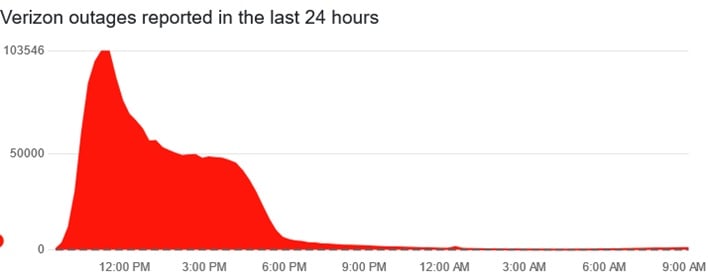
Downdetector data made it clear that this was not a small or localized issue.
- Outage reports surged rapidly from normal baseline levels into the tens of thousands within minutes
- As the outage progressed, reports continued climbing, eventually reaching well over 100,000 user reports nationwide
- At peak impact, total reports approached nearly 200,000, indicating one of the largest Verizon disruptions seen in recent years
- The majority of reports were related to mobile phone service, followed by mobile internet and text messaging issues
Downdetector heat maps showed dense clusters of reports across major metropolitan areas as well as smaller cities, confirming the outage was nationwide rather than regional.
What Customers Experienced
During the outage, Verizon customers commonly reported:
- Phones displaying SOS Only, meaning the device could not connect to Verizon’s network
- Inability to place or receive phone calls
- Text messages failing to send or receive
- Mobile apps and internet access not working unless connected to WiFi
SOS mode typically means the phone cannot authenticate with the carrier network but may still allow emergency calls. For many users, this created confusion and concern, especially when service did not immediately return.
Why This Type of Outage Matters
Cellular networks are no longer just for phone calls. They support:
- Business communications and remote work
- Mobile payment systems and point-of-sale devices
- Emergency communications
- IoT devices, sensors, and monitoring systems
- Home internet connections that rely on cellular service
When a major carrier like Verizon experiences an outage of this magnitude, the impact extends far beyond inconvenience. It can disrupt operations, delay communications, and affect safety-critical services.
Common Reasons for Large Carrier Outages
While carriers often take time to confirm the exact cause, large-scale outages are commonly tied to:
- Core network software or hardware failures
- Issues during network updates or configuration changes
- Problems with authentication or routing systems
- Backhaul connectivity disruptions between cell sites and the core network
Modern cellular networks are highly complex. Even with redundancy built in, a single failure can cascade across multiple systems.
What You Can Do During a Carrier Outage
When a carrier outage occurs, resolution ultimately depends on the carrier. However, there are steps you can take to stay connected:
Use WiFi Calling
If enabled on your device, WiFi calling can allow calls and texts to continue over an internet connection.
Rely on Internet-Based Messaging Apps
Messaging platforms that use WiFi can still function even when cellular service is unavailable.
Monitor Outage Trackers
Tools like Downdetector provide fast insight into whether an issue is widespread or localized.
Restart Your Device After Service Returns
Once service begins restoring, a reboot often helps your phone reconnect cleanly to the network.
The Bigger Takeaway
Downdetector data from January 14 shows just how significant the Verizon outage was, with outage reports skyrocketing into the hundreds of thousands in a short period of time. Events like this highlight the importance of connectivity planning, especially for businesses and users who depend on cellular service as their primary internet connection.
Having backup options like WiFi calling, secondary carriers, or alternative connectivity solutions can make a big difference when major outages occur. Reach out to 5Gstore.com if you need a robust multi-carrier solution.