Table of Contents
If you have been in the networking world long enough, you know router pricing is rarely just about the router. It is about the cost and availability of the components inside it, the cost to build and test it, and the reality that manufacturers adjust pricing when input costs move higher.
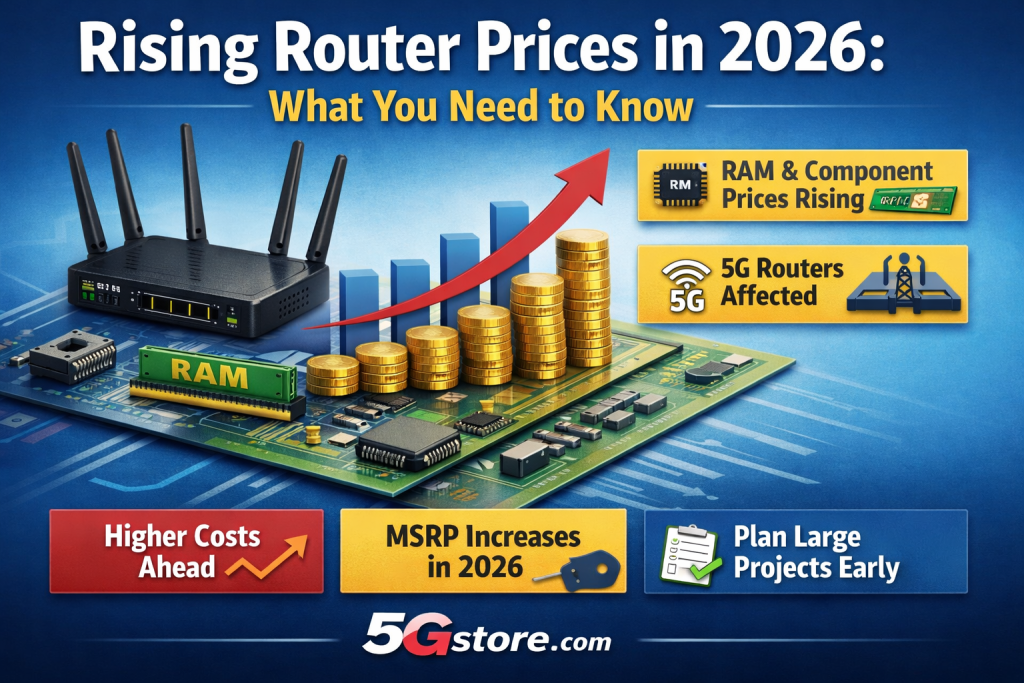
In 2026, one of the biggest drivers of pricing pressure is memory. RAM costs are rising, and that is happening at the same time the global supply chain is feeling new demand from AI infrastructure. The result is simple: router costs are trending up in 2026, and 5G routers are among the most affected categories.
If you have a larger project planned this year, there is a real benefit to purchasing earlier to reduce the risk of mid-year price increases and to lock in current pricing while it is still available.
Routers Are Small Computers, and RAM Is a Core Cost Driver
Modern routers are not just “network boxes.” They are compact computing platforms that run advanced features like:
- VPN encryption and tunnel management
- QoS and traffic shaping
- Stateful firewalling and threat protections
- Multi-WAN health checks and failover logic
- Application awareness, logging, and monitoring
- Web UI, API integrations, and sometimes edge applications
All of that relies heavily on RAM. Many devices also rely on flash storage for firmware, logs, and configuration. When RAM and memory related components rise in price, manufacturers do not have many options. They cannot simply remove memory without impacting performance, stability, and feature support.
The Big 2026 Shift: AI Infrastructure Is Increasing Global Memory Pressure
A common question right now is whether AI is eating into global RAM demand. In many cases, yes.
1) AI data centers consume huge amounts of conventional server RAM
AI workloads require not only GPU horsepower, but also large memory footprints in the servers feeding those GPUs. That increases demand for standard DRAM (for example, DDR5 in servers). When server DRAM demand rises, memory suppliers can prioritize higher-volume, higher-margin segments, tightening availability for other industries.
2) Memory manufacturers are shifting capacity toward AI-focused memory
Many AI accelerators use specialized memory called HBM (High Bandwidth Memory). HBM is premium, high-margin, and in heavy demand. When manufacturers shift production and engineering focus toward HBM and server memory, the effective supply of conventional DRAM for everything else can tighten. That can push up pricing for the types of RAM commonly used across embedded devices and networking products.
What this means for routers
Routers typically use conventional DRAM or LPDDR (not HBM), but they still feel the impact when the broader memory market tightens. When memory is more expensive and supply is more constrained, router manufacturers have higher BOM costs and less flexibility. That pressure eventually shows up as pricing adjustments.
Components That Drive Router Price Increases in 2026
RAM is a headline driver, but it is not the only one. Router pricing is influenced by the entire bill of materials and the cost to manufacture, test, and ship the finished product.
Key components that commonly rise together
- RAM (DRAM or LPDDR): Used for routing tables, session tracking, VPN processing, UI, and features
- Flash storage: Firmware images, logs, configurations, feature packages
- Networking silicon: CPU/SoC, switch chips, and Ethernet PHYs
- Power components: Power management ICs, protection circuits, magnetics
- “Small parts” that add up: Capacitors, connectors, shielding, heatsinks
Additional cost drivers unique to 5G routers
5G routers include expensive and specialized components that WiFi-only gear does not:
- 5G modem modules
- RF front-end components (filters, amplifiers, duplexers)
- Antenna connectors and RF design requirements
- Carrier certification and testing overhead
That is why we expect all 5G routers to be impacted. Even modest increases in these inputs can create noticeable finished-goods price changes.
How Component Increases Typically Turn Into Higher Router Pricing
Manufacturers usually do not adjust pricing every time a single part moves. Pricing changes often happen in steps:
- MSRP updates that take effect mid-year
- Higher distributor costs that ripple into reseller pricing
- Reduced promotions or fewer discount programs
- New hardware revisions introduced at a different price point
Examples of how increases can show up (illustrative)
Every manufacturer’s BOM is different, but the pattern is consistent:
- If a router’s internal BOM cost increases by $25 to $60, the MSRP impact after manufacturing overhead and channel margins can easily land in the $50 to $150 range.
- For 5G routers, a combined rise in memory plus cellular and RF related parts can move the BOM more dramatically, and that often translates into $100 to $250+ MSRP shifts depending on the model class.
These are illustrative examples to help with planning. The key takeaway is that small component changes can become meaningful dollars once they move through the full cost stack.
Why “All 5G Routers” Are Affected Even If Some Brands Move Later
It is tempting to think one manufacturer might avoid increases. In reality, 5G routers share major cost drivers:
- Similar modem and RF cost structures
- Higher memory requirements to support features and throughput
- Certification and validation overhead
- More complex thermal and power design
Some product lines may see adjustments earlier than others depending on inventory position and purchasing agreements, but the broader category is exposed to the same market forces.
If You Have a Bigger 2026 Project, Buying Earlier Can Protect Your Budget
If you are planning a rollout this year, purchasing earlier can help you in three practical ways:
1) Lock in pricing before increases take effect
When price changes are announced, they usually have an effective date. Purchasing ahead of that date often secures pre-increase pricing.
2) Reduce risk from lead-time swings
When memory and key components tighten, lead times can become less predictable. Buying earlier reduces schedule risk.
3) Improve budget certainty for multi-site deployments
Even modest per-unit increases multiply quickly at scale.
A few quick examples:
- 100 routers with a $125 increase per router equals $12,500
- 1,000 routers with a $125 increase per router equals $125,000
If your deployment is planned and funded, pulling purchasing forward can be the simplest way to avoid unplanned budget creep.
Practical Buying Strategies for 2026
If your organization has a rollout planned this year, these steps help reduce exposure:
- Finalize your shortlist early: Approve models now so you can move quickly if pricing changes.
- Buy core hardware earlier, deploy in phases: Purchase now, stage installation over time.
- Include spares up front: Buying spares later can cost more and risk delays.
- Confirm quote validity windows: Many quotes have expiration dates, especially in volatile component cycles.
- Work with a partner who stocks inventory: Availability matters as much as price when timelines are tight.
At 5Gstore.com, we keep a deep inventory position across major 5G router brands and accessories, and we help customers plan deployments to balance budget, availability, and performance requirements. Here is an interesting article on what is happening.
FAQ
Is AI infrastructure increasing global RAM demand?
Yes. AI data centers deploy huge amounts of server memory, and that increased demand can tighten supply and raise pricing in the broader DRAM market.
Do routers use the same RAM that AI systems use?
Not exactly. Many routers use DRAM or LPDDR, while many AI accelerators use HBM. But when memory manufacturers prioritize high-margin AI-related memory and server DRAM, it can reduce supply flexibility and push prices up across the wider memory ecosystem.
Will only certain 5G router brands increase prices?
Pricing timing varies by manufacturer, but the same component pressures affect the entire category. Over time, most 5G routers are exposed to these cost drivers.
Are non-5G routers impacted too?
Often yes. WiFi and wired routers still rely on RAM, flash, CPUs, switch chips, and power components. The impact may be smaller than 5G models, but it is not isolated to cellular gear.
If I buy earlier in 2026, can I lock in pricing?
In many cases, yes. Purchasing before price changes take effect can secure current pricing. Quote windows and availability matter, so earlier action typically reduces risk.
Should I buy extra units now for spares?
If uptime matters, buying spares earlier is often smart. It helps you avoid future price increases and protects you from unexpected lead-time changes.
What about accessories like antennas and cables?
Accessories can be affected too, especially items that rely on electronics components, RF materials, and manufacturing costs. Planning accessory needs early is a good idea for large rollouts.
What is the best next step if I have a big deployment planned?
Lock down your requirements (throughput, VPN needs, dual-SIM, GPS, WiFi, management features), estimate quantities including spares, then purchase earlier if your timeline allows.