Table of Contents
If you follow wireless news, you have seen the 5G headline whiplash. One day there are gigabit demos, the next day there are stories about short range. The reality is that 5G is a big umbrella. It covers very different frequency ranges and use cases. For businesses, the smart approach is not to hunt for a single fastest tower. The winning move is to blend multiple links into one resilient network fabric that stays up, performs smoothly, and is simple to manage.
This post translates a technical 5G whitepaper into practical guidance for IT teams, field operations, and anyone planning a rollout.
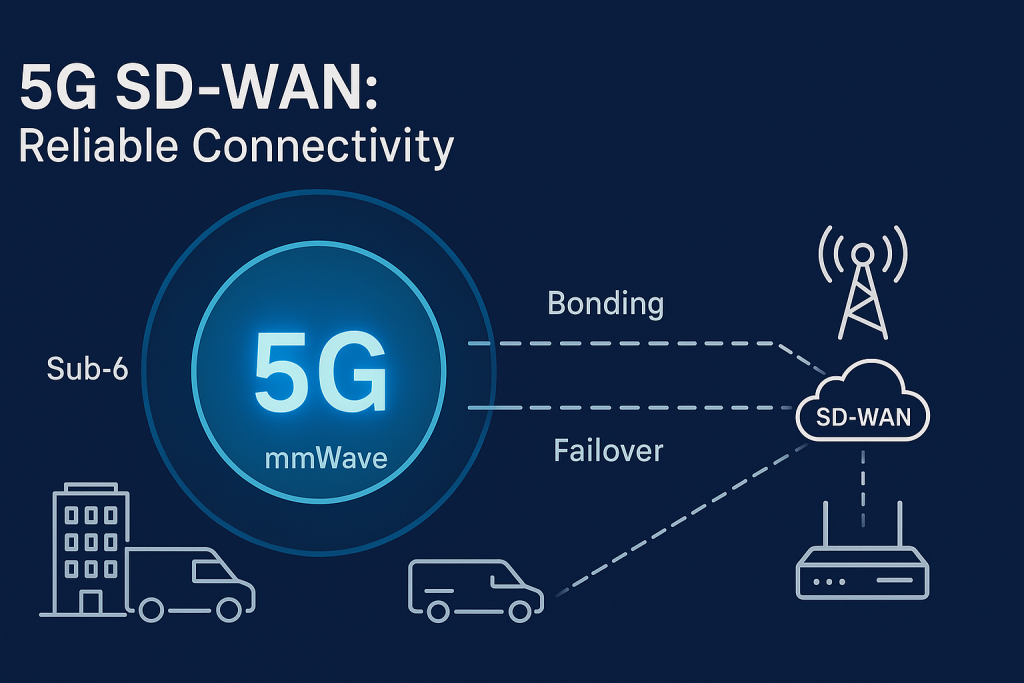
5G is not one thing: sub-6 vs mmWave
5G operates across a wide spectrum.
- Sub-6 GHz (roughly 600 MHz to 3.5/4 GHz):
This is the coverage layer. It delivers steady speed gains over LTE and tends to penetrate buildings better. Most enterprise deployments will rely on sub-6 because it offers predictable performance over broader areas. - mmWave (about 24 to 100 GHz):
This is the speed layer. It can deliver multi-gigabit downloads and very low latency, but physics is the catch. At these frequencies signals struggle through walls and even heavy humidity, and line-of-sight matters. Practical range can be quite short unless you have dense small-cell coverage.
Takeaway: Design for coverage and reliability first, then take advantage of mmWave where it exists. Build your WAN so it thrives on sub-6 today and can opportunistically capitalize on mmWave as it becomes more available.
Hardware matters: you need 5G-capable endpoints
Enjoying 5G requires 5G-capable routers and modems, but the bigger real-world boost often comes from combining multiple connections rather than swapping a single modem. Multi-WAN, multi-cellular designs let you mix carriers, frequencies, and even fiber or cable so the network keeps performing when one path is not ideal.
Why SD-WAN is the real star of the 5G era
Traditional MPLS gave predictable paths, but it is expensive and rigid. A wireless SD-WAN approach replaces that rigidity with intelligent traffic steering, bonding, and automated failover across diverse links. This is where Peplink’s SpeedFusion stack shines:
- Bandwidth Bonding: Aggregate multiple links so they behave like one bigger pipe. Great for high throughput and latency-sensitive workloads.
- Carrier Agnostic Coverage: Mix carriers to reduce blind spots and avoid dependency on a single network.
- Hot Failover: Maintain encrypted tunnels on all links so if one drops, active sessions continue on a healthy path with no fuss.
- Centralized Orchestration: Manage branches and mobile fleets from the cloud with consistent policies.
For retail, healthcare, public safety, transportation, construction, and other sectors, this combination often delivers a bigger upgrade than raw radio speed alone. What users notice is resilience, consistency, and control.
Performance is more than “up or down”: tackle packet loss
A link can be “up” yet still feel bad because of packet loss and jitter. That is why quality tools matter:
- WAN Smoothing: Duplicates packets across links so if one path loses a packet, the twin arrives via another path. Ideal for two-way apps like Zoom, Teams, and VoIP.
- Forward Error Correction (FEC): Sends parity data so the receiver can reconstruct lost packets. Great for one-way streams and live broadcasts.
These techniques stabilize call quality and video even when you are riding challenging cellular conditions.
Four practical upgrade paths (from simplest to most robust)
You do not have to rip and replace. Here are common on-ramps we see succeed.
- Add a 5G path with MAX Adapter 5G
If your Peplink router supports USB WAN, the MAX Adapter 5G is a fast way to add a 5G link for smart failover or a second SD-WAN path. It is a low-friction way to test 5G or boost resilience without a full hardware swap. - Single-cellular 5G at the edge: MAX BR1 Pro 5G
A workhorse for vehicles, pop-up sites, kiosks, and branch backup. Use it as primary 5G where wired is not feasible, or as 5G failover behind fiber or cable. With Wi-Fi 6, 2.5 GbE WAN, and SpeedFusion features, it is a versatile step up. - Branch-class multi-WAN: Balance 310 5G family
Pick the variant that fits your mix:- Balance 310 5G: 5G plus Ethernet WAN for hybrid sites.
- Balance 310X 5G: Dual Ethernet WANs plus 5G for higher availability.
- Balance 310 Fiber 5G: SFP for gigabit fiber with 5G failover.
These are great for office resilience, traffic steering, and SD-WAN aggregation across carriers and ISPs.
- Mission-critical multi-cellular: MBX 5G
When downtime is not an option, the MBX 5G stacks multiple 5G modems and SIMs and bonds them into a single, low-latency pipe. Ideal for public safety command, mobile production, large vehicles, and industrial sites where throughput and uptime are everything.
Real-world planning tips
- Design for diversity: Use two or more carriers when you can. Sub-6 behaves differently block to block, so combining carriers reduces blind spots.
- Keep wired in the mix when possible: Fiber or cable plus 5G gives the best of both worlds. Let SD-WAN steer traffic so each path does what it does best.
- Prioritize quality, not just speed tests: Enable WAN Smoothing for collaboration tools and FEC for streaming. Users will notice fewer glitches and better voice quality.
- Place antennas intentionally: For fringe sub-6 or any mmWave opportunity, antenna choice and placement can make or break performance.
- Centralize control: Use cloud management to push policies, view utilization, and catch issues early with analytics and alerts.
- Iterate: Start with a single 5G path for failover, then add bonding or additional modems as needs grow. SD-WAN makes incremental improvements straightforward.
Where this is headed
Enterprises are connecting more devices, vehicles, and temporary sites than ever. Portable, rapidly deployable bandwidth is now a core requirement. Sub-6 5G provides the dependable foundation. mmWave can supercharge specific hotspots. The glue is SD-WAN, especially solutions like Peplink SpeedFusion that blend links, heal packet loss, and fail over instantly. That is how businesses move from a fast proof of concept to a durable, production-grade WAN that keeps teams online and applications crisp.
Need help choosing the right path?
Whether you are outfitting a single branch, a nationwide fleet, or a temporary site that needs to be live today, we can help you pick the right mix of hardware, carriers, antennas, and policies, and stage it for a clean rollout.