Table of Contents
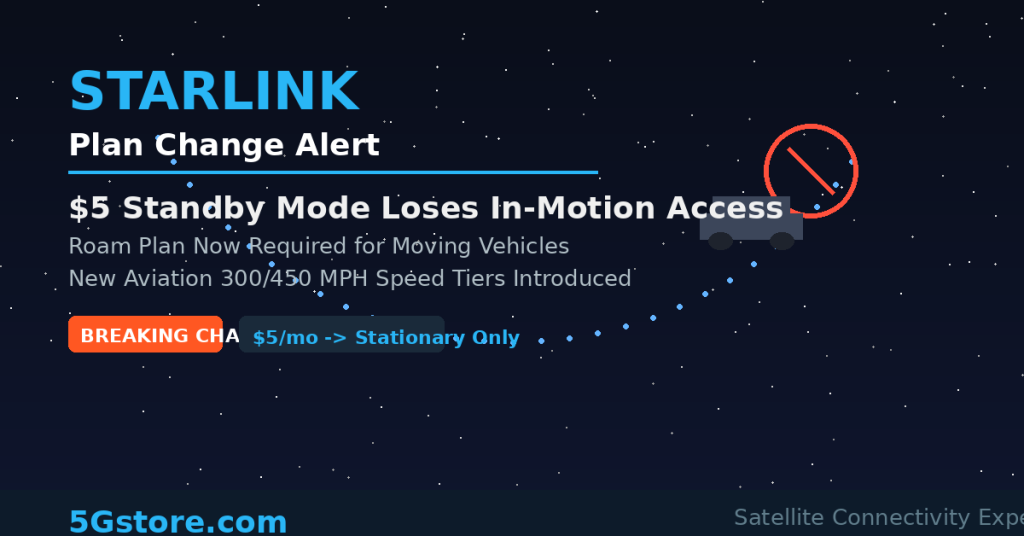
If you have been relying on Starlink Standby Mode as a low-cost backup for road trips and remote travel, this week brought an unwelcome surprise. SpaceX has officially blocked in-motion use for subscribers on the $5 per month Standby Mode plan, ending what many considered the best bargain in satellite internet for mobile connectivity.
What Is Standby Mode?
Starlink introduced Standby Mode in August 2025 as a replacement for the platform’s free pause feature. For $5 per month, the plan kept your hardware active on the Starlink network with unlimited data throttled to 500 Kbps (0.5 Mbps). That speed is roughly equivalent to early 2G cellular service, but it proved to be just enough for basic navigation, turn-by-turn mapping, messaging, and occasional light web browsing while moving down the highway.
For many road trippers, RV travelers, and Starlink Mini owners, the plan became a practical emergency connectivity tool that cost almost nothing. When paired with the compact Starlink Mini dish, which fits neatly in a vehicle or camper, the $5 tier punched well above its weight in rural and dead-zone environments where cellular coverage disappears.
What Just Changed?
Starting this week, Starlink users on the Standby plan began receiving a “Starlink Disabled while moving” alert inside the mobile app whenever their dish detected motion. SpaceX has updated its official support documentation to reflect the new reality: “Pausing your service with Standby Mode is not intended for in-motion use.”
No advance notice was provided to subscribers. The change was discovered by users on Friday and spread quickly across Reddit, Facebook groups, and tech forums. Reaction ranged from frustrated to furious, with some users threatening to return the Starlink Mini dishes they had received as part of a promotional loan program.
The New In-Motion Speed Cap on Roam and Priority Plans
The crackdown on Standby Mode is not the only change SpaceX made this week. Starlink has also introduced a 100 mph (roughly 160 km/h) speed cap for in-motion use on its Roam, Local Priority, and Global Priority plans. Previously, those plans allowed operation at speeds up to 450 mph, which made them viable for use on small private aircraft.
To serve aviation users going forward, Starlink has introduced two new plan tiers specifically designed for flight:
- Aviation 300 MPH at $250 per month
- Aviation 450 MPH at $1,000 per month
Pilots and aviation enthusiasts who previously used consumer Roam or Priority plans for real-time weather data and cockpit connectivity will now need to migrate to one of these specialized tiers.
What Are Your Options Now?
If you were using Standby Mode in a moving vehicle, your main path forward is upgrading to the Starlink Roam plan, which starts at $50 per month. That is a 10x price increase over what many were paying, which understandably stings.
Here is a quick breakdown of how the plans now compare for mobile use:
| Plan | Monthly Cost | In-Motion | Speed |
|---|---|---|---|
| Standby Mode | $5 | No | 500 Kbps |
| Roam (entry) | $50 | Yes (under 100 mph) | Full speed |
| Aviation 300 MPH | $250 | Yes (under 300 mph) | Full speed |
| Aviation 450 MPH | $1,000 | Yes (under 450 mph) | Full speed |
Not sure which Starlink plan is available at your location? Coverage and plan availability vary by address. Check Your Coverage Area to see what is offered where you are.
Why Did Starlink Make This Change?
SpaceX has not issued a formal statement explaining the decision. Community speculation points to straightforward plan abuse. One Facebook commenter summed it up bluntly: “Too many people abused it, so they had to lock it down. Same story over and over again.” The plan was never explicitly marketed for in-motion use, but neither was it technically restricted until now.
This is consistent with Starlink’s history of making unannounced changes to plan terms that affect large segments of its user base. The company has a track record of introducing low-cost options, watching adoption patterns, and then tightening restrictions once usage exceeds intended scope.
What This Means for Road Warriors and RV Travelers
For the nomad community, this is a meaningful loss. Standby Mode had become a go-to recommendation for emergency satellite connectivity on the road. At $5 per month, it was cheap enough to maintain year-round even for seasonal travelers who only needed occasional coverage. At 500 Kbps, it was barely adequate but surprisingly useful for maps and messaging in the areas that needed it most.
Moving to a $50 Roam plan may make financial sense for full-time RVers and frequent road travelers, but for the casual road tripper who wanted a $5 safety net in cellular dead zones, the math no longer works the same way.
Pairing Starlink with Cellular for True Redundancy
One lesson here is the risk of relying on a single connectivity plan or technology, regardless of how inexpensive it seems. For serious mobile connectivity, a hybrid approach combining Starlink with 4G and 5G cellular gives you genuine redundancy when either link degrades or, in this case, gets administratively blocked.
Peplink routers like the Peplink B One 5G and MAX series support Starlink as a WAN input alongside cellular carriers, with SpeedFusion bonding for seamless failover. If Starlink goes down or loses in-motion eligibility, your cellular link takes over automatically without dropping a session. For fleet operators, RV travelers, and anyone who cannot afford to be offline on the road, that kind of setup is worth serious consideration.
Our team has helped thousands of customers configure Starlink alongside cellular routers for exactly this kind of resilience. For more background on integrating Starlink into a multi-WAN setup, check out our post on Starlink plan options and pricing.
5Gstore Take
Starlink continues to evolve its plan structure in ways that sometimes benefit customers and sometimes do not. The loss of in-motion use on Standby Mode is a real downgrade for anyone who depended on it as an affordable road travel backup. The 100 mph speed cap on Roam and Priority plans will also catch some users off guard, particularly pilots who assumed their existing plan covered aviation use.
If you are reevaluating your mobile connectivity strategy after these changes, we are here to help. Whether you need a Starlink-compatible router, a cellular backup solution, or a full multi-WAN build for your vehicle, fleet, or RV, our team can walk you through the options. Reach out to us and let us help you stay connected wherever you are going.
FAQ
Can I still use Starlink Standby Mode while parked?
Yes. Standby Mode still works when your dish is stationary. The restriction applies only to in-motion use, so it remains a valid low-cost option for maintaining your account and getting basic connectivity at a fixed location.
What plan do I need to use Starlink in a moving vehicle?
You need a Starlink Roam plan, which starts at $50 per month. Standby Mode no longer supports in-motion use as of March 2026.
Does the new 100 mph speed cap affect RV users?
For most RV and vehicle use cases, the 100 mph cap should not be a practical issue since most road travel stays well under that threshold. The cap primarily affects pilots using consumer-grade Starlink plans.
What are the new Starlink aviation plans?
Starlink has introduced two aviation-specific plans: Aviation 300 MPH at $250 per month and Aviation 450 MPH at $1,000 per month. These replace consumer Roam and Priority plans for in-flight use.
Is there a way to keep using Starlink cheaply on the road?
Not at the $5 price point anymore. The Roam plan at $50 per month is now the entry point for any in-motion satellite use. Pairing it with a cellular data plan and a multi-WAN router gives you the best coverage and backup options for mobile use.
Did Starlink give any warning before making this change?
No. Subscribers discovered the restriction when the “Starlink Disabled while moving” message appeared in their app. Starlink updated its support documentation but did not announce the change in advance.