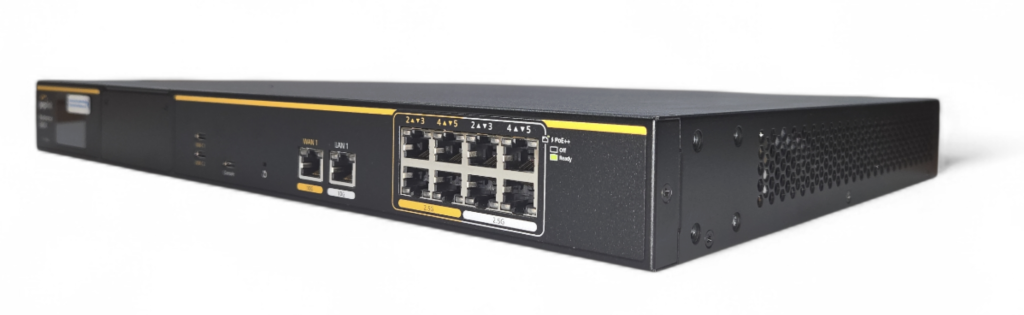
Quick spec recap
- Hardware revision: Rev 2 (new version)
- Price: $3,999 with PrimeCare included (about $1,000 less than HW1)
- Router throughput: up to 8 Gbps
- Multi-gig flexibility: 4x 2.5 GbE ports configurable as WAN or LAN
- PoE++ outputs: 8 ports
- Total PoE budget: 720W
- SpeedFusion throughput: up to 1 Gbps with or without encryption
Peplink has refreshed its high-end Balance lineup with the new Balance 580X Next Generation router, and this update is more than just a pricing change. This model is technically Hardware Revision 2 (Rev 2), and it arrives with two upgrades customers have been asking for: more multi-gig ports and higher router throughput.
Even better, Rev 2 is the first Balance 580X version that includes PrimeCare and it comes in at $3,999, which is $1,000 less than Hardware Revision 1 (HW1).
If you are building networks where bandwidth is climbing and downtime is unacceptable, the 580X Rev 2 is designed to be a true multi-gig edge platform that can also simplify deployments by powering heavy-duty devices directly from the router.
What’s new with Balance 580X Rev 2 (and why it matters)
1) PrimeCare included, lower price
The new Balance 580X Rev 2 includes PrimeCare at $3,999, making it $1,000 less than HW1. That is a meaningful reduction for enterprise deployments where you may be purchasing multiple routers across sites.
2) More 2.5 GbE ports for modern networks
Rev 2 increases multi-gig connectivity, which is critical as more networks move to 2.5 GbE switching, high-throughput WiFi, and faster internet circuits. Specifically:
- 4x 2.5 GbE ports can be configured as WAN or LAN
That flexibility lets you design your edge around your needs: stack multiple internet circuits, segment traffic, or build a multi-gig LAN without forcing everything through a single 1G bottleneck.
3) Higher performance: up to 8 Gbps router throughput
The Balance 580X Rev 2 steps up routing performance with up to 8 Gbps router throughput. For organizations with multi-gig WAN circuits, large site traffic, or busy VPN usage, this is the kind of capacity that helps keep your router from becoming the choke point.
Built for multi-WAN reliability and SpeedFusion
The Balance series is known for intelligent multi-WAN behavior and Peplink’s SpeedFusion technology, which is often used to keep sessions stable during link issues and to improve overall WAN resilience.
With the 580X Rev 2, you can expect:
- Multi-WAN continuity features that keep operations running when a carrier or ISP has problems
- Up to 1 Gbps SpeedFusion throughput, with or without encryption
That “with or without encryption” detail matters if you are pushing serious bandwidth over bonded links or encrypted tunnels and want predictable performance.
PoE++ power at the edge: simplify installs and reduce failure points
One of the most practical upgrades for real-world deployments is PoE++ support on the Balance 580X Rev 2.
Here’s what that means in plain terms:
- The router can power connected devices directly, which reduces the need for separate injectors and extra cabling
- Fewer components means fewer things to fail in the field, and faster installs for your team
Key PoE++ details:
- 8x PoE++ outputs
- Total PoE power budget: 720W
Why PoE++ is especially useful for 5G deployments
Peplink’s PoE++ approach can be a clean way to integrate 5G into your network using external solutions like Peplink Dome or Antenna MAX. In many edge deployments, the biggest headaches are not the routing features, but the “stuff around it”: injectors, power supplies, long cable runs, and clutter in enclosures.
With PoE++, the 580X Rev 2 can help streamline those deployments while also powering heavier-draw devices like:
- Pan-tilt-zoom (PTZ) cameras
- WiFi 7 access points
Who should consider the Balance 580X Rev 2?
The Balance 580X Rev 2 is a strong fit if you have one or more of these needs:
- Multi-gig internet now (or soon) and you do not want your router limiting performance
- Multiple WAN links that you want to actively use, load balance, or fail over between
- SpeedFusion use cases where you want consistent, predictable tunnel performance
- Edge builds that benefit from PoE++, especially where you are powering cameras, access points, or 5G endpoints
- Organizations deploying standardized hardware across multiple sites and wanting PrimeCare included
5Gstore Take
The Balance 580X Rev 2 is the kind of “upgrade that actually matters.” You are not just getting a refreshed model, you are getting meaningful, real-world improvements: more multi-gig flexibility with 2.5GbE WAN/LAN ports, a jump to up to 8 Gbps routing capacity, and the ability to power serious edge gear with 8x PoE++ and a 720W budget. Add in 1 Gbps SpeedFusion performance with or without encryption and PrimeCare included at $3,999 (about $1,000 less than HW1), and Rev 2 becomes a strong choice for anyone standardizing on a high-performance Peplink platform for multi-site networks, multi-WAN resiliency, and clean 5G-ready deployments. Need assistance, contact 5Gstore or place your order for a Peplink Balance 580x Rev 2 (now in stock).
FAQ: Balance 580X Rev 2
Is the new Balance 580X the same as the old one?
Not exactly. The new model is Hardware Revision 2, which includes PrimeCare and is priced $1,000 less than HW1, with key upgrades like more 2.5 GbE capability and up to 8 Gbps router throughput.
What does “4x 2.5 GbE ports can be WAN or LAN” mean?
It means you can choose how those ports are used. You can dedicate more ports to internet connections (WAN), more to your internal network (LAN), or split them based on your design.
How does PoE++ help in the real world?
PoE++ lets the router power devices directly over Ethernet, reducing injectors, power bricks, and extra cabling. That can speed up deployments and reduce points of failure.
Is the 580X Rev 2 good for powering WiFi 7 access points or PTZ cameras?
Yes. The 580X Rev 2 includes 8 PoE++ outputs and a 720W total PoE budget, which is designed for heavier-draw devices.
What is the SpeedFusion throughput on the 580X Rev 2?
It supports up to 1 Gbps throughput with or without encryption, which is helpful for high-performance bonded and encrypted connectivity use cases.