Table of Contents
When networks are deployed in the real world, they are rarely sitting safely in a climate-controlled server room. They are mounted in vehicles, bolted to heavy machinery, installed at industrial job sites, or supporting first responders where reliability is critical.
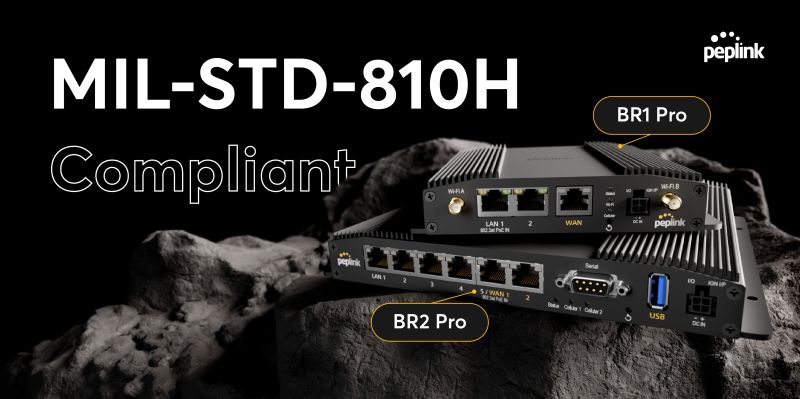
That is why we are excited to share that the Peplink BR1 Pro and Peplink BR2 Pro are now MIL-STD-810H compliant, specifically tested and certified for shock and vibration resistance.
This is not a marketing buzzword. It is a meaningful certification that directly impacts uptime, longevity, and real-world performance.
What Is MIL-STD-810H?
MIL-STD-810H is a United States Department of Defense testing standard used to evaluate how equipment performs under harsh environmental conditions.
Rather than testing products in ideal lab environments, MIL-STD-810H focuses on realistic stress scenarios, including:
- Mechanical shock
- Continuous vibration
- Temperature extremes
- Humidity
- Dust and sand exposure
- Operational stresses encountered during transport and deployment
The “H” revision is the most current version of the standard and reflects modern deployment environments, materials, and testing methods.
In short, if a device passes MIL-STD-810H testing, it has demonstrated that it can survive conditions far more demanding than typical office or retail installations.
Why Shock and Vibration Testing Matters
For many 5Gstore customers, shock and vibration are the most common causes of equipment failure.
Examples include:
- Routers installed in construction vehicles or heavy equipment
- Fleet and mobile command vehicles that operate on rough terrain
- Public safety and first responder vehicles that are in constant motion
- Industrial environments with continuous mechanical vibration
- Mobile kiosks, trailers, and pop-up deployments that are frequently transported
Over time, vibration can loosen connectors, damage internal components, and lead to intermittent failures that are extremely difficult to diagnose.
MIL-STD-810H shock and vibration testing validates that the BR1 Pro and BR2 Pro can withstand these forces without compromising performance or reliability.
What This Means for BR1 Pro and BR2 Pro Deployments
With MIL-STD-810H compliance, the BR1 Pro and BR2 Pro are now proven choices for deployments where downtime is not acceptable.
Key Benefits
- Increased reliability in mobile and industrial environments
- Reduced risk of hardware failure due to vibration or impact
- Longer service life when mounted in vehicles or machinery
- Greater confidence for mission-critical applications
These routers are designed not just to function in challenging environments, but to keep operating consistently when conditions are unpredictable.
Ideal Use Cases
MIL-STD-810H compliance makes the BR1 Pro and BR2 Pro especially well suited for:
- First responder and public safety vehicles
- Fleet connectivity and vehicle-mounted networking
- Construction sites and heavy equipment
- Utilities, oil and gas, and industrial automation
- Mobile command centers and temporary deployments
If your network equipment is exposed to motion, vibration, or physical stress, this certification matters.
BR1 Pro vs BR2 Pro: Choosing the Right Rugged Router
Both models now meet the same shock and vibration standards, so your choice comes down to deployment needs.
- BR1 Pro is ideal for single-cellular, compact, and cost-effective deployments where ruggedness and reliability are still required.
- BR2 Pro is designed for higher availability environments, supporting dual cellular connections for redundancy and increased resilience.
Both models deliver enterprise-grade performance in a form factor built for the field.
Proven Hardware for Critical Networks
When failure is not an option, certifications like MIL-STD-810H provide confidence that your equipment is up to the task.
The BR1 Pro and BR2 Pro are now validated to handle the shock and vibration common in real-world deployments, making them excellent choices for industrial, mobile, and mission-critical networking.
Explore the products here:
If you are unsure which model fits your environment, the 5Gstore team is always available to help design a solution that matches your reliability requirements.
FAQ Section
What does MIL-STD-810H mean?
MIL-STD-810H is a U.S. Department of Defense testing standard used to evaluate how equipment performs under harsh environmental conditions. It focuses on real-world stresses such as shock, vibration, temperature extremes, humidity, and transport conditions rather than ideal lab environments.
What was tested on the BR1 Pro and BR2 Pro?
The Peplink BR1 Pro and BR2 Pro were tested specifically for shock and vibration, validating that the hardware can withstand physical impacts and continuous motion commonly found in vehicles, heavy equipment, and industrial environments.
Why is shock and vibration testing important for cellular routers?
Shock and vibration are leading causes of hardware failure in mobile and industrial deployments. Over time, constant movement can loosen connectors, damage internal components, and cause intermittent network outages. MIL-STD-810H testing confirms the router can operate reliably in these conditions.
Are MIL-STD-810H routers only for military use?
No. While the standard originates from military testing, MIL-STD-810H is widely used in commercial industries such as public safety, utilities, transportation, construction, and industrial automation where equipment must perform reliably in harsh environments.
What industries benefit most from MIL-STD-810H compliant routers?
Industries that benefit the most include first responders, fleet and vehicle connectivity, construction, utilities, oil and gas, manufacturing, and any deployment where networking equipment is exposed to motion, vibration, or physical stress.
Does MIL-STD-810H mean the router is indestructible?
No. MIL-STD-810H does not mean the device is indestructible. It means the router has been tested to survive specific environmental stresses under defined conditions and is significantly more resilient than standard commercial networking equipment.
Should I choose the BR1 Pro or BR2 Pro?
Choose the BR1 Pro for compact, single-cellular deployments that still require rugged reliability. Choose the BR2 Profor higher-availability environments that need dual-cellular connectivity and additional redundancy. Both models now meet the same MIL-STD-810H shock and vibration standards.